


The most expensive tool isn't always the right one for your tool belt, especially when speed on-site is your primary metric. It's frustrating to spend half a shift manually typing out long sequences only to have labels peel off in harsh Australian conditions. When weighing up the dymo rhino 5200 vs 6000+, you need a reliable system that meets local wiring standards without failing mid-job.
This comparison breaks down the critical differences in connectivity, tape width, and durability to help you choose the right industrial workhorse for your specific requirements. We'll examine how each model handles complex data, dusty environments, and high-volume labelling tasks to ensure your next investment from DymoOnline delivers the efficiency you need on the tools. We focus on providing practical guidance to help you organise your warehouse or electrical projects with confidence and long-term reliability.
Key Takeaways
- The Rhino 5200 serves as a rugged standalone tool for field repairs, whereas the 6000+ acts as a workflow integration device with PC connectivity.
- A key factor in the dymo rhino 5200 vs 6000+ decision is label size, with the 6000+ offering support for 24mm tapes to create clearer warning signs.
- Large-scale data and electrical installations benefit from the 6000+ model's ability to import complex data batches from Excel, minimising on-site typing.
- Both units help tradespeople meet AS/NZS 3000 standards by utilising specialised industrial materials like flexible nylon and heat shrink tubing.
Comparing Hardware: The Rugged 5200 vs the Connected 6000+
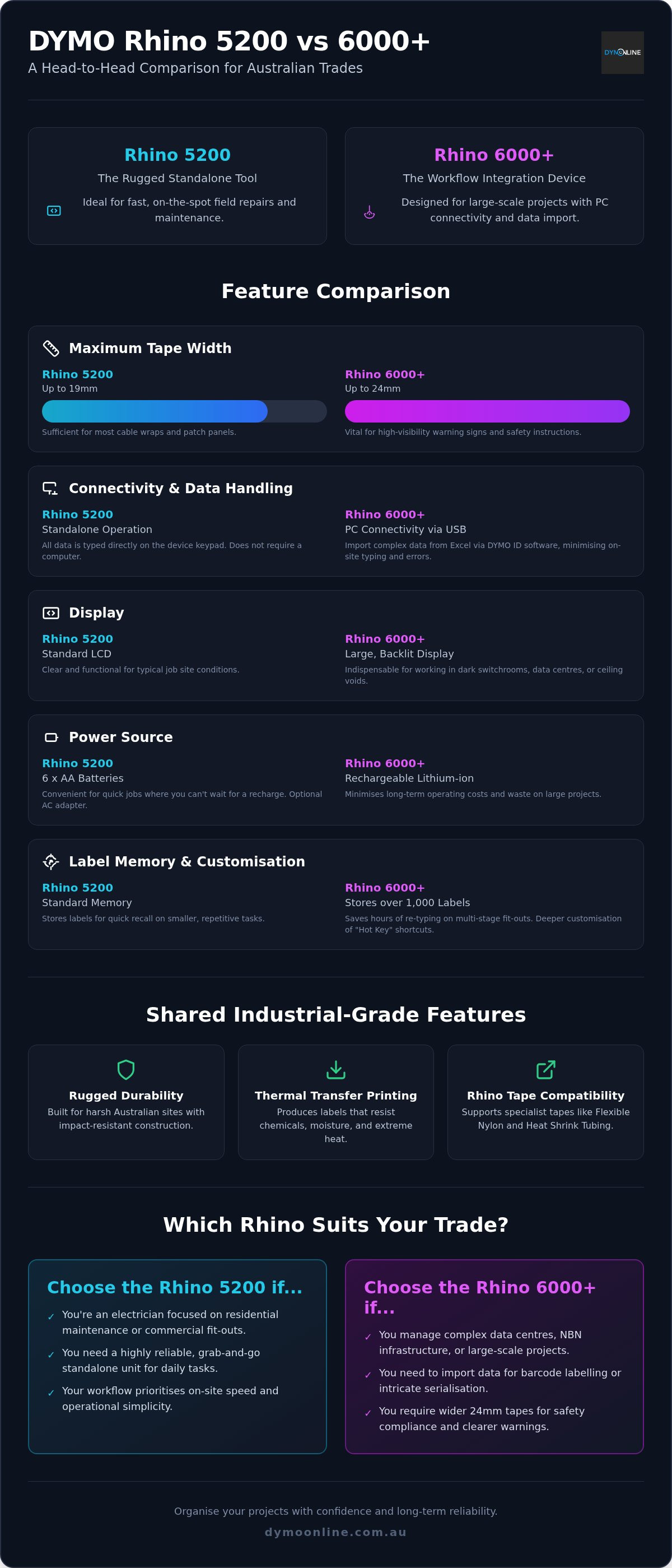
The Rhino 5200 is built for the rough reality of Australian construction sites. It features a thick, integrated rubber bumper that protects the internal components from accidental drops and impacts on concrete floors. In contrast, the 6000+ focuses on digital integration. It includes a USB port for PC connectivity, allowing you to use the modern DYMO ID software to design complex layouts or import data before you even arrive on-site. Both machines utilise thermal transfer printing to produce durable labels that resist chemicals, moisture, and extreme heat.
When comparing the dymo rhino 5200 vs 6000+, visibility and interface speed are major factors. The 6000+ boasts a significantly larger, backlit display. This feature is indispensable when you're working in dark switchrooms, cramped data centres, or ceiling voids. While both models use "Hot Keys" for one-touch formatting of wire wraps, flags, and panel labels, the 6000+ offers deeper customisation for these shortcuts to suit specific site workflows and repetitive tasks.
Key Differences in Portability and Power Management
Power requirements often dictate which DYMO label maker is right for your tool kit. The 5200 runs on six AA batteries or an optional AC adapter. This setup is convenient for quick maintenance calls where you don't want to wait for a battery to charge. The 6000+ typically includes a rechargeable lithium-ion battery pack as standard, which helps minimise long-term operating costs and waste. If you're performing extensive overhead work, the 5200 is slightly more compact. Its ergonomics allow for steady one-handed operation while you're balancing on a ladder or working in a tight crawl space.
Labelling Capacity and Tape Compatibility
While both devices are rugged, their output capability varies significantly based on your specific application. A primary differentiator in the dymo rhino 5200 vs 6000+ comparison is the maximum tape width. The 5200 supports tapes up to 19mm, which is sufficient for most cable wraps and patch panels. However, the 6000+ handles 24mm tapes. This extra width is vital for creating high-visibility warning signs or safety instructions that meet Australian workplace labelling requirements. Using wider labels allows for larger fonts and clearer symbols, which is a major benefit in expansive industrial warehouses.
Both machines are compatible with Rhino Industrial Tape, including flexible nylon for curved surfaces and polyester labels for flat, textured panels. This versatile DYMO label tape ensures compliance in demanding environments. The 6000+ can store over 1,000 labels in its internal memory for repeat use on multi-stage projects. This feature saves hours of re-typing during large-scale fit-outs where identical labels are needed across different floors or zones.
Maximising Utility with Rhino Industrial Tapes
In Australian electrical centres, using Rhino Heat Shrink Tube Tape is the standard for secure wire identification. The 6000+ is the preferred choice for large-scale heat shrink tube applications due to its ability to handle wider diameters for heavy-duty cabling. For outdoor assets exposed to the harsh Australian sun, Rhino Vinyl Tape is a reliable solution. It offers the UV resistance and colour-coding options needed to ensure labels don't fade or peel over time. If you're unsure which tape grade suits your site, our team can help you identify the right consumables for your project.
Which Rhino Suits Your Australian Trade Requirements?
Choosing between the dymo rhino 5200 vs 6000+ often comes down to the scale of your installations and your preferred workflow. For electricians focused on residential maintenance or straightforward commercial fit-outs, the standalone Rhino 5200 provides excellent speed and value. It's a reliable field unit that doesn't require a computer to operate effectively. A Pro Tool Reviews analysis of the Rhino 5200 highlights its rugged build and intuitive interface as key strengths for contractors who need a durable tool for daily tasks.
Conversely, data cablers and IT managers managing complex server rooms or NBN infrastructure should lean towards the 6000+. This model is essential for projects involving barcode labelling or intricate serialisation that would be tedious to type manually on a keypad. By utilising Excel-based data uploads, you can accurately label hundreds of patch panel ports in a fraction of the time. You can browse the full range of DYMO machines at DymoOnline to compare these specific technical capabilities for your next project.
Workflow Integration and Site Efficiency
The ability to pre-print labels before arriving on-site is a significant advantage for large-scale infrastructure projects. The 6000+ allows you to organise your entire labelling strategy from the office using the DYMO ID software, ensuring every cable and panel is accounted for before the first technician starts. This level of preparation minimises errors and keeps projects on schedule. DymoOnline provides expert support for Australian businesses looking to scale their industrial labelling capabilities, ensuring you have the right tools and consumables for every environment.
Equipping Your Trade for Professional Results
Selecting the right tool depends entirely on your daily site demands. If you need a standalone, rugged device for quick field fixes, the Rhino 5200 remains a reliable choice for any tool belt. However, for those managing complex data centres or large-scale infrastructure, the 6000+ offers efficiency through PC connectivity and wider 24mm tape support. When evaluating the dymo rhino 5200 vs 6000+, prioritising your specific workflow will ensure you meet Australian labelling standards with ease.
As an established DYMO specialist, DymoOnline provides the expert technical support and nationwide Australian delivery required to keep your operations running smoothly. We're here to help you find the right solution for your specific industrial environment. Contact our team for expert advice on the Rhino range today. We look forward to helping you organise your next project.
Frequently Asked Questions
Can I use the Rhino 6000+ with my Windows or Mac computer?
Yes, the Rhino 6000+ connects to a computer via USB to use the DYMO ID software. This software is compatible with Windows 10 and later versions, allowing you to design labels on a larger screen before printing. While it's primarily a Windows-based solution, it significantly speeds up complex projects compared to using the handheld keypad alone for every entry.
Does the Rhino 5200 support heat shrink tubing for wire marking?
Yes, the Rhino 5200 is fully compatible with DYMO heat shrink tubing. It supports tubing widths up to 19mm, making it a reliable choice for electricians who need to mark wires and cables. When comparing the dymo rhino 5200 vs 6000+, remember that both models use the same industrial-grade materials to ensure durability in harsh Australian environments.
What is the main difference between the old Rhino 6000 and the new 6000+ model?
The primary difference lies in the software integration and modern connectivity. The 6000+ uses the current DYMO ID software for PC-based design, whereas the legacy Rhino 6000 relied on the older Rhino Connect platform. This update ensures compatibility with modern operating systems and provides a more streamlined interface for importing data from spreadsheets during large-scale infrastructure fit-outs.
Which Rhino model is better for labelling large patch panels in data centres?
The Rhino 6000+ is the more efficient choice for high-density data centre environments. Its ability to import data from Excel via the USB connection eliminates the need for manual typing, which reduces errors on large patch panels. While the 5200 is a capable field tool, the 6000+ provides the batch printing capabilities and 24mm tape width needed for professional infrastructure identification.

Article by
DymoOnline Team
The DYMOOnline Team provides practical guidance for Australian businesses, warehouses, retailers, offices, schools, healthcare workplaces and home users who rely on accurate, efficient labelling. DYMOOnline specialises in DYMO label makers, DYMO label printers, label tapes, label rolls, shipping labels, address labels, barcode labels and labelling accessories, helping customers choose the right labelling products for organisation, mailing, inventory, filing, pricing and workplace efficiency.
General Information
This article is provided as general information only to help customers compare and choose DYMO label makers, label printers, label tapes, label rolls, shipping labels, address labels, barcode labels and related labelling supplies. Product details, specifications, compatibility, availability, pricing and suitability may vary. Always check the individual product page, manufacturer information, printer model compatibility and label size requirements before purchasing or using a product.


