
Genuine DYMO D1 Labels: The Ultimate Australian Buyer’s Guide
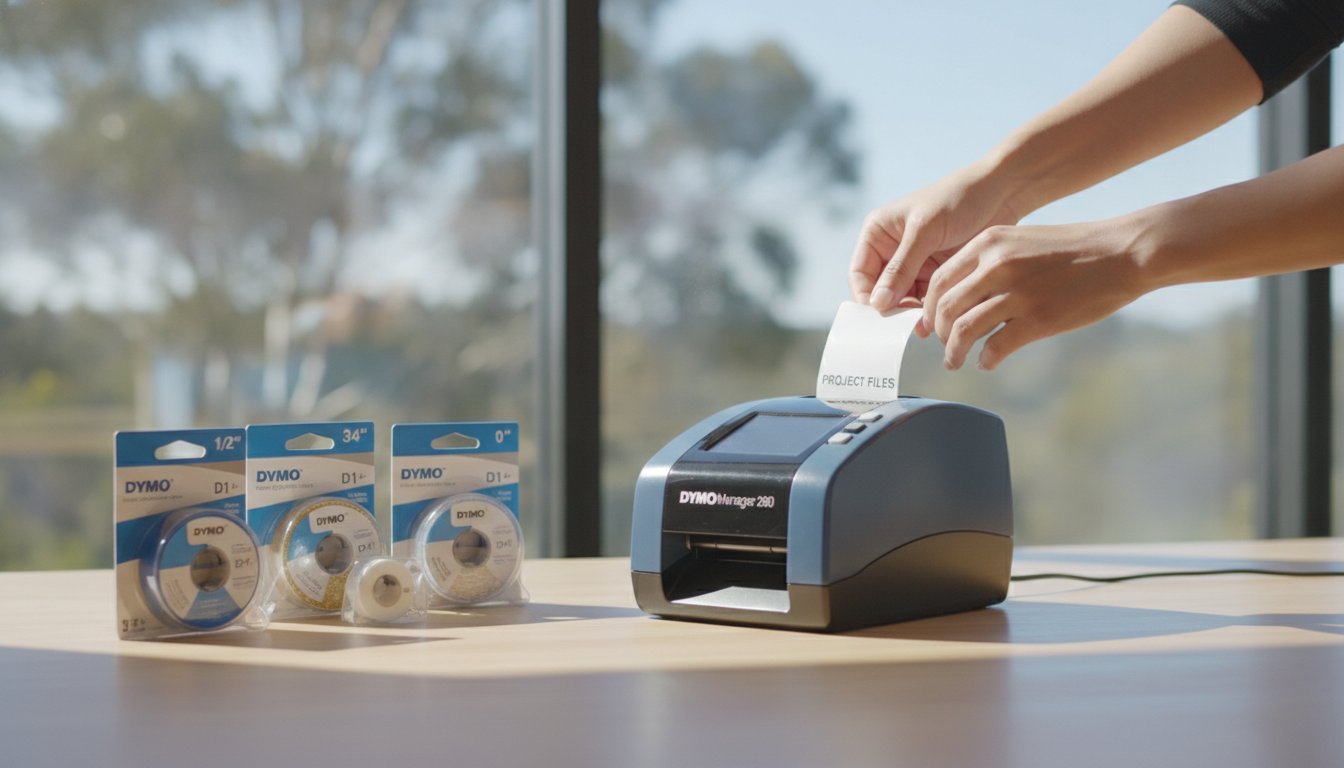
A single jammed cassette or a set of peeling labels can cost your business far more in lost productivity and professional reputation than you ever saved by choosing generic tapes. Most office managers and warehouse supervisors recognise the frustration of labels failing in harsh Australian heat or seeing vital information fade in a sunlit office. When you rely on dymo d1 labels for your daily operations, you need the certainty that your identification will stay put and remain legible under local conditions.
This guide will help you master the Dymo D1 labelling system to ensure perfect compatibility, maximum durability, and professional results for your Australian workplace. By choosing genuine consumables, you protect your hardware and ensure your identification remains legible for years. We will examine how to identify the correct tape width and material for your specific surface, ensure long-term adhesion in demanding environments, and find a reliable local supplier with efficient shipping. Whether you are managing a fleet of LabelManager 210D units or a single Rhino 4200, we provide the technical clarity you need to choose the right consumable with absolute confidence.
Key Takeaways
- Learn how the "Easy-Peel" split-back design and thermal transfer technology streamline labelling tasks in busy Australian workplaces.
- Identify which genuine dymo d1 labels are compatible with your LabelManager or Rhino printer to ensure maximum hardware reliability.
- Discover the essential differences between standard and durable tapes to prevent label fading and peeling in the harsh Australian climate.
- Master the correct loading techniques and ribbon-tightening procedures to eliminate common cassette jams and ribbon loops.
- Ensure you are sourcing authentic supplies from a specialist Australian provider to guarantee product integrity and fast nationwide shipping.
Understanding the Genuine DYMO D1 Label System
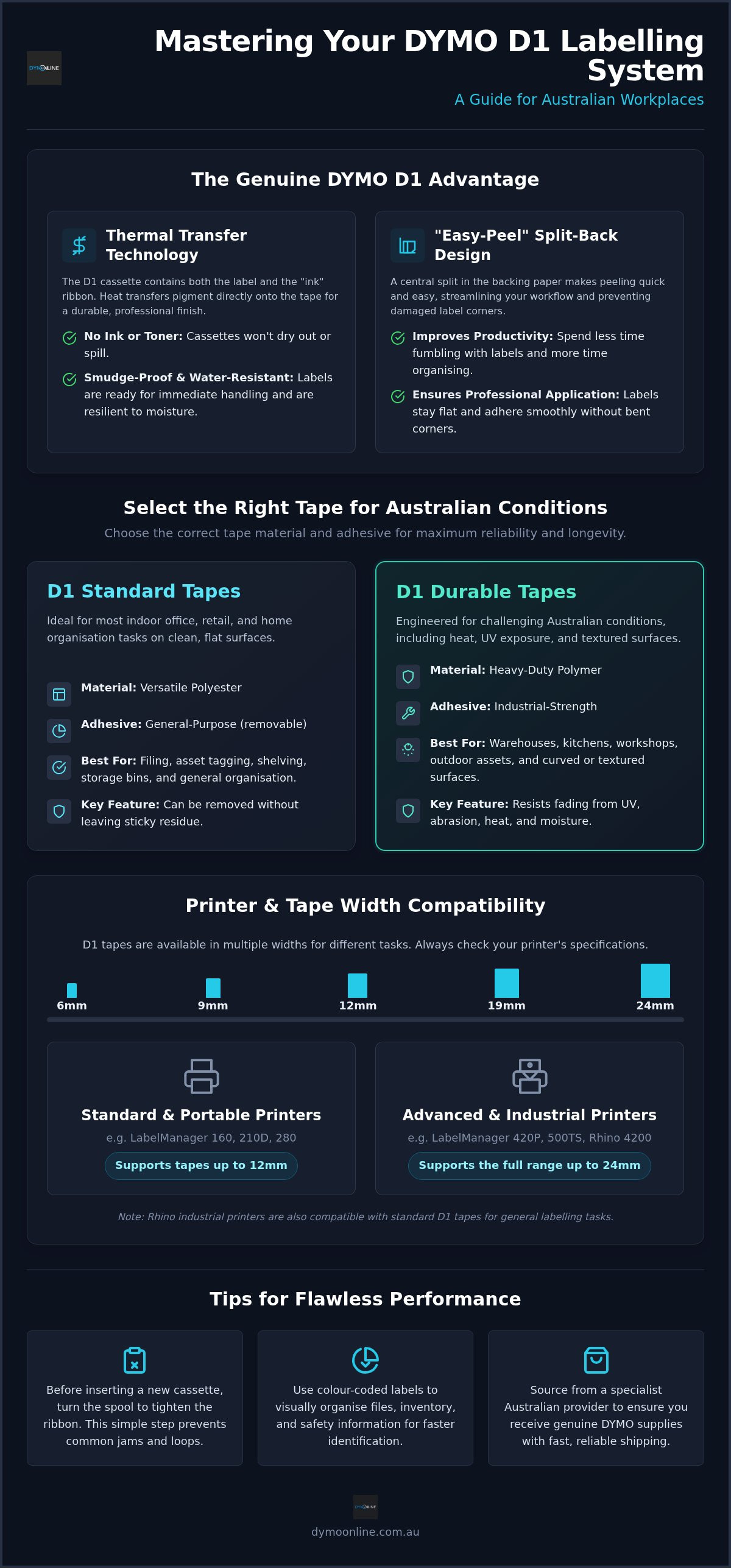
D1 cassettes are the backbone of the DYMO portable ecosystem. They use thermal transfer technology, which is fundamentally different from the inkjet or laser printing you might use for standard office documents. The DYMO Corporation history shows a long-standing commitment to professional-grade identification; the D1 system is a culmination of that expertise. These self-adhesive cassettes house both the label material and the thermal ribbon, ensuring a closed system that protects the print head of your device from dust and debris.
Because the "ink" is contained within the D1 cassette ribbon, you don't have to worry about toner spills or ink cartridges drying out. The heat from the print head transfers the pigment directly onto the tape, resulting in smudge-proof, water-resistant text. This makes dymo d1 labels particularly effective for Australian work environments where labels are often handled immediately after printing or exposed to varying humidity levels in a warehouse or medical centre.
A practical feature that sets genuine tapes apart is the "Easy-Peel" split-back design. The backing paper is sliced down the centre, allowing you to peel it away quickly without fumbling or damaging the adhesive layer. In a fast-paced office environment, this small design choice significantly improves productivity and ensures the label remains flat and professional upon application. It's a simple solution that prevents the common frustration of corner-peeling often found with inferior third-party alternatives.
The Cross-Series Versatility of D1 Tapes
One of the primary advantages for Australian businesses is the cross-compatibility of the D1 format. It serves as the standard cassette for a wide range of machines, from the entry-level LabelManager 160 to the heavy-duty Rhino 5200. This versatility allows you to maintain a single inventory of tapes that work across your entire fleet of LabelManager devices, simplifying your procurement process.
While the Rhino Industrial series can use specialised "IND" labels for extreme conditions, these machines are also fully compatible with standard dymo d1 labels. This means your industrial teams can use standard tapes for general office duties, filing, or asset tagging, and then switch to specialised industrial tapes only when the environment demands it. It's a cost-effective way to manage your labelling needs without sacrificing performance or hardware longevity.
Selecting the Right D1 Tape for Australian Conditions
Choosing the right tape for your workplace involves more than just picking a colour. You must consider the surface material and the environmental stressors the label will face. For most indoor applications, LabelManager D1 Standard tapes provide an ideal balance of cost and performance. These polyester tapes are perfect for filing, asset tagging, and general organisation within air-conditioned Australian offices.
The range of dymo d1 labels varies significantly in width to suit different tasks. Sizes start at 6mm, which is perfect for slim file spines or laboratory vials, and extend up to 24mm for large-format shipping alerts or warehouse shelf markers. It is vital to check your specific printer model's specifications before purchasing. Entry-level devices like the LabelManager 160 typically support up to 12mm tapes, while more advanced units like the LabelManager 420P can handle the full 24mm range.
Standard vs. Durable: Which Adhesive Do You Need?
Standard D1 tapes feature a versatile polyester material that is removable without leaving a sticky residue. This makes them ideal for temporary signage or items that require frequent re-labelling, such as plastic storage bins or shared office equipment. However, if your labels will be exposed to the elements or high-traffic areas, you should opt for the LabelManager D1 Durable range.
Durable tapes are engineered with industrial-strength adhesive and increased resistance to fading and abrasion. This is crucial in Australia, where high UV levels can cause rapid deterioration of standard materials. Academic research into how plastics degrade in sunlight highlights the severe impact of radiation on polymer structures; genuine durable tapes are specifically designed to mitigate these effects. They remain adhered to curved and textured surfaces even when exposed to moisture or extreme heat in local warehouses.
Colour Coding Your Australian Workplace
Using different colours helps staff identify items at a glance, improving efficiency and safety. Black on yellow is the industry standard for safety warnings and hazard alerts. In contrast, white on clear provides a sleek, professional look for glass partitions or retail displays. High-contrast combinations, such as black on white, are also essential for reliable barcode scanning in Australian logistics and retail environments. If you're unsure which material or colour suits your specific application, you can contact our specialist team for expert guidance.
Maximising Performance: Loading and Maintenance
Proper installation is the primary factor in preventing cassette failure. Before you insert a new cassette, you should always turn the rewind gear on the back of the cassette clockwise. This simple step tightens the ribbon and prevents the loose "loops" that cause most jams. When you place the cassette into the machine, ensure the tape passes directly between the print head and the drive roller. If the printer displays a "Tape Jam" error, avoid pulling the tape forcefully. Instead, remove the cassette, check for adhesive buildup, and ensure the ribbon is taut before re-insertion.
Protecting Your Portable Printer
Using generic dymo d1 labels can lead to long-term hardware damage. These third-party alternatives often have inconsistent tape thickness that strains the drive motor of your LabelManager. The thermal print head is the sensitive component that requires the smooth coating of genuine D1 tape for longevity. To maintain cut quality, you should periodically clean the cutter blade with a cotton swab dipped in isopropyl alcohol. This removes the microscopic adhesive residue that causes the tape to snag or fold during the cutting process.
Where to Buy Genuine D1 Labels in Australia
To guarantee the performance of your labelling system, it is best to source your supplies from an Australian specialist. Sourcing from DymoOnline ensures you avoid grey-market stock that may have been stored in substandard conditions, which often results in expired or weakened adhesive. For large-scale industrial projects or office relocations, Bulk DYMO packs provide a professional solution for high-volume requirements. We offer nationwide shipping with same-day dispatch for major Australian metro areas, providing the reliability your business needs to stay organised.
Optimise Your Australian Workplace Labelling Today
Selecting the correct consumables is the most effective way to protect your printer investment and ensure your identification remains clear for years. By choosing genuine dymo d1 labels, you eliminate the risks of adhesive failure in the Australian sun and prevent unnecessary mechanical strain on your LabelManager or Rhino devices. You've learned how to identify the right material for your environment and how simple maintenance, such as tightening the ribbon gear, can prevent common hardware frustrations.
DymoOnline provides specialist Australian support and a 100% Genuine DYMO Guarantee on every order. Our nationwide shipping, dispatched through Mega Office Supplies, ensures your team remains productive with minimal downtime. If you're managing a large-scale project or maintaining a fleet of industrial printers, we can help you find the most efficient solution for your specific requirements.
Enquire About Bulk D1 Labels for Your Business to streamline your procurement and secure your workplace organisation. We're ready to assist you in achieving lasting, professional results for your office or warehouse.
Frequently Asked Questions
Do D1 labels work in all Dymo LabelManager machines?
Yes, dymo d1 labels are the universal cassette format designed for the entire LabelManager series. While the cassette shape is identical across the range, you must ensure your specific printer supports the tape width you intend to use. For instance, the LabelManager 160 supports widths up to 12mm, while high-end models like the LabelManager 420P can accommodate the full 24mm range.
What is the difference between D1 and D1 Durable labels?
Standard D1 tapes are made from polyester and feature a removable adhesive that leaves no residue, making them ideal for indoor office organisation. In contrast, the Durable range uses industrial-strength adhesive and more robust materials. These are specifically engineered to resist abrasion and chemical exposure, ensuring they remain adhered to challenging surfaces like textured metal or curved plastic in warehouse environments.
How do I stop my Dymo D1 tape from jamming?
The most effective way to prevent jams is to tighten the internal ribbon before inserting the cassette. Always turn the rewind gear clockwise until the ribbon is taut against the tape. Additionally, ensure the tape is threaded correctly between the print head and the drive roller. Regularly cleaning the cutter blade with isopropyl alcohol will also prevent adhesive buildup from snagging the tape during a print job.
Are Dymo D1 labels waterproof and UV resistant?
Standard dymo d1 labels are water-resistant and can withstand occasional splashes and indoor light exposure without fading. However, for applications involving submersion or direct exposure to the harsh Australian sun, the Durable range is the superior choice. These labels are specifically formulated with UV-resistant coatings and waterproof adhesives to prevent the peeling and legibility issues commonly caused by local climate conditions.

Article by
DymoOnline Team
The DYMOOnline Team provides practical guidance for Australian businesses, warehouses, retailers, offices, schools, healthcare workplaces and home users who rely on accurate, efficient labelling. DYMOOnline specialises in DYMO label makers, DYMO label printers, label tapes, label rolls, shipping labels, address labels, barcode labels and labelling accessories, helping customers choose the right labelling products for organisation, mailing, inventory, filing, pricing and workplace efficiency.
General Information
This article is provided as general information only to help customers compare and choose DYMO label makers, label printers, label tapes, label rolls, shipping labels, address labels, barcode labels and related labelling supplies. Product details, specifications, compatibility, availability, pricing and suitability may vary. Always check the individual product page, manufacturer information, printer model compatibility and label size requirements before purchasing or using a product.
Latest News
Genuine DYMO D1 Labels: The Ultimate Australian Buyer’s Guide
A single jammed cassette or a set of peeling labels can cost your business far more in lost produc...
Dymo Rhino vs Panduit Label Makers: The Best Choice for Australian Trades in 2026
You might assume that spending significantly more on a high-end label maker guarantees a better re...
Small Business Label Printer Australia: The 2026 Guide to Automated Labelling Systems
Imagine spending your Monday morning handwriting fifty delivery addresses, only to have several parc...
Australian Food Safety Label Requirements: A 2026 Compliance Checklist
Could your current food labels trigger a mandatory recall after 25 February 2026? It is a critical q...
Choosing the Best Australia Post Shipping Label Printer for Your Business in 2026
We understand that as your order volume increases, you need a reliable australia post shipping label...
Asset Tag Printer: 2026 Australian Buying Guide
When an expensive piece of portable equipment goes missing from a job site or office, the real cost...