
Australian Food Safety Label Requirements: A 2026 Compliance Checklist
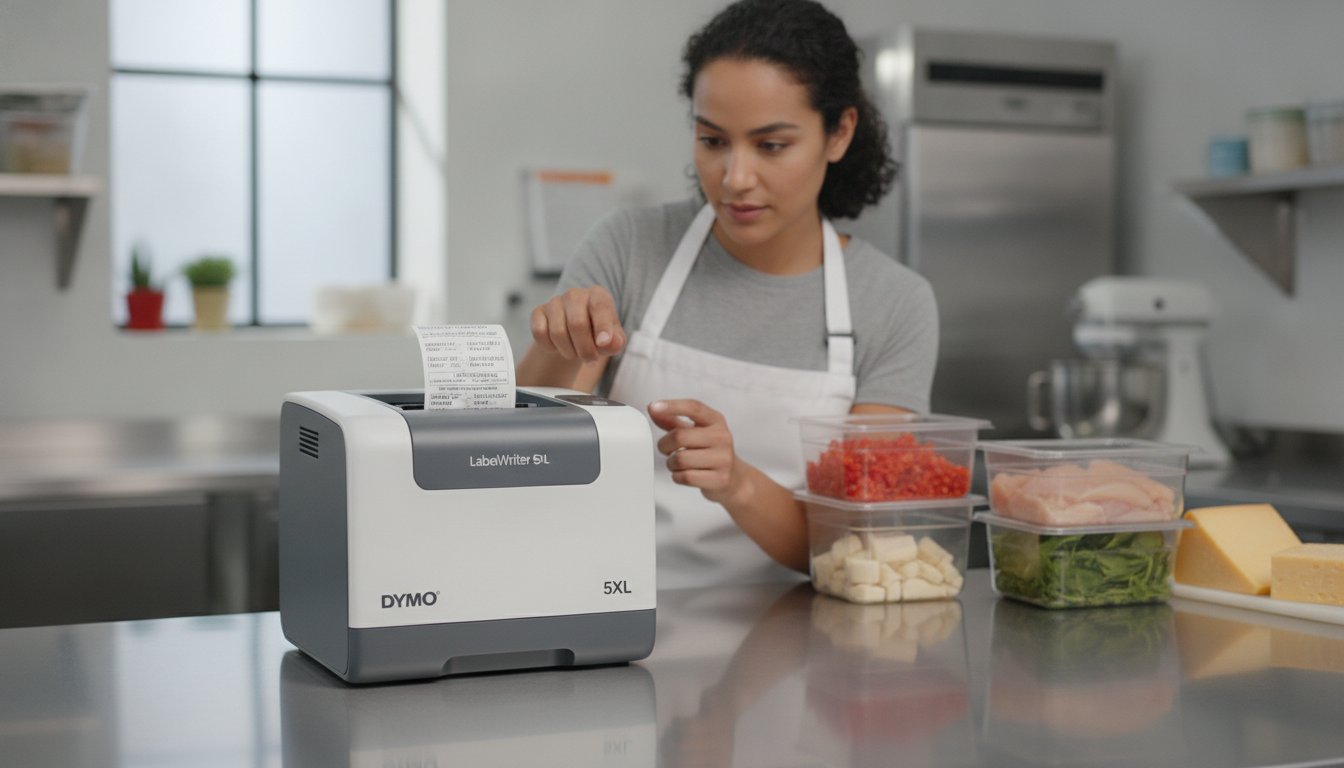
Could your current food labels trigger a mandatory recall after 25 February 2026? It is a critical question every local business owner must answer as the final deadline for Plain English Allergen Labelling (PEAL) rapidly approaches. We understand that staying on top of the Australian food safety label requirements often feels like a constant battle against complex government jargon and shifting regulations. You've likely felt the frustration of trying to keep labels legible in a damp kitchen environment or the lingering worry that a single missing bold word could result in a heavy fine during your next audit.
Our guide is designed to replace that confusion with total confidence. We'll help you master the essential standards of the Australian Food Standards Code by breaking down the latest mandates into a clear, actionable checklist. You will learn exactly how to format allergen statements, manage new energy labelling for beverages, and discover efficient ways to produce professional labels in-house. From choosing the right adhesive for freezer storage to ensuring your LabelWriter 5XL is configured for high-volume prep, this practical guide provides the peace of mind you need to keep your operations compliant and your customers safe.
Key Takeaways
- Understand the legal necessity of the Food Standards Australia New Zealand (FSANZ) Code and how to ensure your retail labels remain compliant through 2026.
- Learn how to implement the final Plain English Allergen Labelling (PEAL) updates to meet australian food safety label requirements before the February 2026 deadline.
- Discover the practical steps for accurate lot and batch number identification to streamline recall management and maintain essential food safety records.
- Identify why moving away from handwritten labels to professional systems like the LabelWriter 5XL reduces human error and ensures legibility in busy kitchens.
- Select the correct label materials, such as durable moisture-resistant rolls, to ensure your compliance information stays attached and readable in fridge or freezer environments.
Mandatory Information for Food Labelling in Australia
Every food product sold in Australia must adhere to a strict set of rules to ensure consumer safety and transparency. The primary regulatory framework is the Australia New Zealand Food Standards Code. This code is a legal requirement that dictates exactly how information must be presented to the public. If your labels are missing mandatory data or are difficult to read, you risk heavy penalties and immediate product recalls. Compliance is not optional; it is the foundation of a professional food business.
Compliance also involves the "Truth in Labelling" provisions under Australian Consumer Law. These laws ensure that businesses do not mislead customers about the nature, origin, or quality of their food. Using a professional system like a DYMO LabelWriter helps maintain accuracy and consistency. This significantly reduces the risk of making accidental, misleading representations on your packaging, providing you with the peace of mind that your business is fully protected.
To better understand how these regulations apply to your daily operations, watch this helpful video from the NSW Food Authority:
The Core Pillars of the Food Standards Code
Chapter 1 of the Code sets out the general standards that apply to almost all food products. It covers everything from substances added to food to basic labelling requirements. Chapter 2 provides more granular, category-specific rules for items like meat, dairy, and alcoholic beverages. State agencies and local councils across Australia enforce these standards through regular inspections. They check that all australian food safety label requirements are met, focusing on accuracy and the presence of mandatory warnings.
Legibility and Presentation Standards
It is not enough to simply include the required information; it must be legible. Warning statements often have specific minimum font size requirements to ensure they are prominent. High contrast between the text and the background is essential for readability. This is where professional thermal printing excels. By using LW Standard labels, you achieve crisp, smudge-proof text. Unlike handwritten notes or standard ink prints, thermal labels do not fade or bleed. This ensures your data remains clear and compliant even in demanding environments.
Your 2026 Food Safety Labelling Compliance Checklist
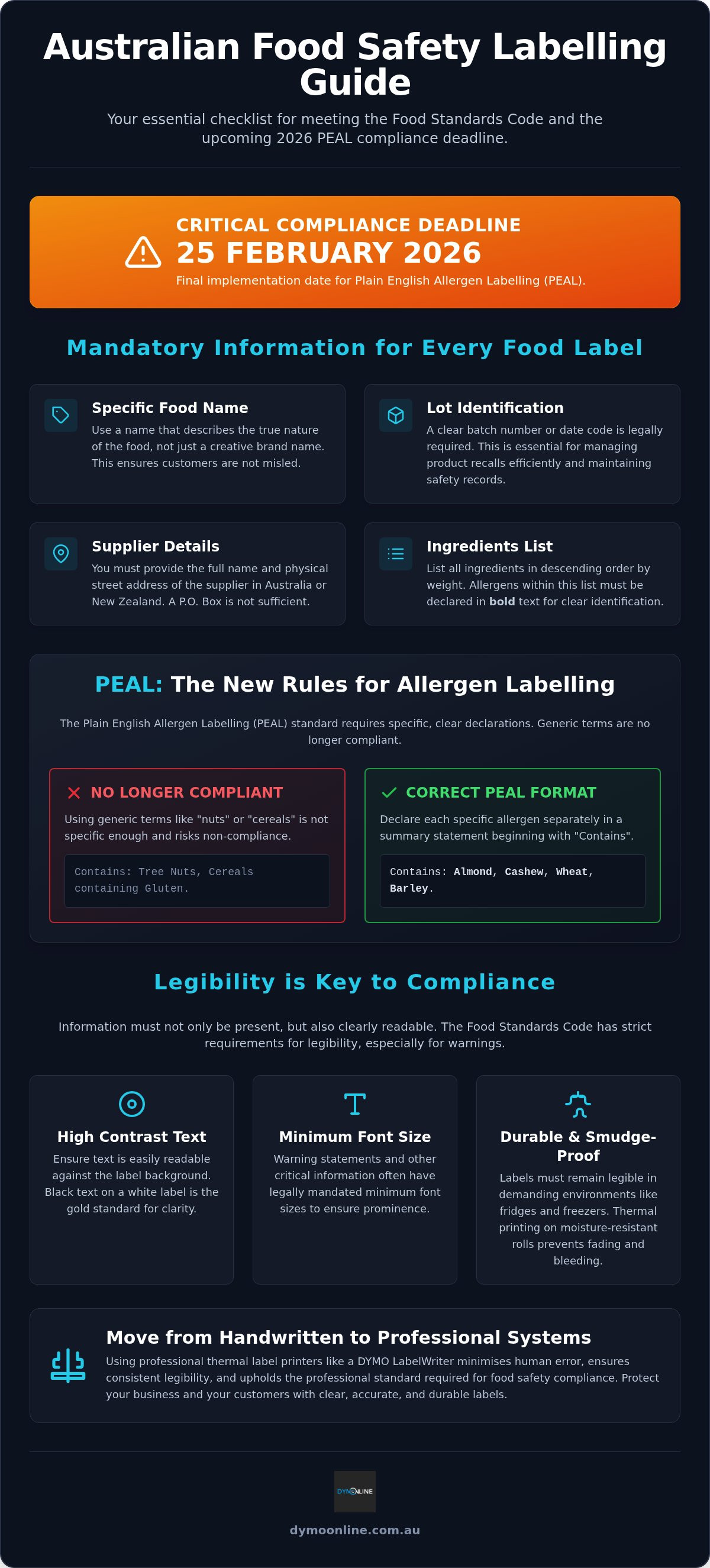
Meeting the final 25 February 2026 deadline for Plain English Allergen Labelling (PEAL) is a priority for every local food manufacturer. This checklist ensures your packaging aligns with current australian food safety label requirements. Every label must act as a clear communication tool between your business and the consumer, providing specific data that can be understood at a glance. To remain compliant, ensure your labels include the following mandatory elements:
- Specific Name: Use a description that accurately reflects the food's true nature rather than just a brand name.
- Lot Identification: A batch number or date code is essential for recall management; it must be clearly visible to health authorities.
- Supplier Details: You must include the name and physical street address of the Australian or New Zealand supplier. A post office box is not sufficient.
- Allergen Declarations: Allergens must be bolded in the ingredient list and repeated in a consistent summary statement beginning with the word "Contains".
The PEAL regulations require that individual tree nuts, such as almonds or cashews, and specific cereals like wheat or barley, be declared separately. Generic terms are no longer acceptable. If you are unsure which label size best fits these mandatory tables, reach out to our team for expert compatibility advice.
Ingredients and Nutritional Data
Ingredients must be listed in descending order by ingoing weight. If your product features a characterising ingredient, such as "Honey" in honey roasted nuts, you must declare its percentage. For complex lists, the LabelWriter 5XL provides the necessary width to accommodate both the ingredient list and the mandatory Nutrition Information Panel (NIP) table without compromising font size.
Dates, Storage, and Origin
Understanding the safety implications of date marking is vital. A "Use By" date is a strict safety limit; food cannot be legally sold or consumed after this date. In contrast, "Best Before" relates to quality. You must also provide storage instructions, such as "Store below 5°C," to ensure the food remains safe until the stated date. Finally, confirm your Country of Origin Labelling (CoOL) includes the kangaroo logo and bar chart where required by law. For a broader overview of non-food items, you can review general Australian product labelling rules.
Streamlining Food Labelling with Professional Systems
Transitioning from manual methods to automated printing is the most effective way to minimise human error in your kitchen. Handwritten labels are often prone to smudging, illegibility, and simple omissions that can lead to a compliance breach. By implementing a digital system, you ensure that every batch of food carries a clear, professional record that stands up to the scrutiny of health inspectors. This shift not only protects your business from fines but also organises your workflow for high-volume prep periods.
Using digital templates is a strategic way to ensure your australian food safety label requirements are met across every product range. Once a template is configured with the correct bolding for allergens and specific font sizes for warning statements, it can be reused with total consistency. This eliminates the risk of a staff member forgetting a mandatory element during a busy shift. Consistency is the hallmark of a compliant operation, and professional hardware provides the reliability needed to maintain these standards.
Choosing the Right Labelling Hardware
The Dymo LabelWriter 5XL is specifically designed for businesses requiring wide-format prints. It is the ideal solution for printing comprehensive Nutrition Information Panels and long ingredient lists without sacrificing legibility. For smaller tasks such as shelf-edge marking or storage bin identification, portable solutions like the LabelManager 160 offer flexibility. Thermal printing technology is particularly beneficial in food-sensitive areas because it requires no ink or toner, reducing the risk of chemical contamination in your prep space.
Adhesives and Environments
Kitchens are harsh environments. Between high temperatures during cooking and the freezing cold of industrial chillers, standard paper labels often fail. It is essential to select materials that can withstand moisture and grease without peeling. Genuine LabelWriter Durable labels are engineered for these exact conditions. These labels use a stronger adhesive that remains secure during freezer storage, ensuring that your compliance data stays attached and readable throughout the entire shelf life of the product.
Securing Your 2026 Compliance Strategy
Maintaining compliance with the evolving australian food safety label requirements doesn't have to be a source of stress for your business. By moving away from manual, error-prone processes and adopting professional thermal printing, you ensure every ingredient list and allergen declaration remains perfectly legible. It's a simple change that yields long-term peace of mind. The final 2026 deadlines make it more important than ever to verify that your batch coding and storage instructions are printed on materials that can survive the moisture and cold of a commercial kitchen.
DymoOnline has provided reliable solutions for Australian food businesses since 2009, offering the seniority and expertise you need to navigate these regulations. We provide specialist Australian support and nationwide shipping for all genuine DYMO supplies, ensuring you have the right tools to protect your reputation and your customers. Browse our range of DYMO LabelWriters for compliant food labelling and ensure your operations are ready for the next audit. With the right systems in place, you can focus on your craft while knowing your labelling is accurate and durable.
Frequently Asked Questions
Do I need a food label if I am selling at a local market?
Yes, almost all food sold at Australian markets requires a label unless it falls under narrow exemptions, such as being made and sold at the same stall. Even without a full label, you are legally required to provide allergen information if a customer asks. Labelling your products ensures you meet australian food safety label requirements and helps build trust with your local community.
What is the difference between a Use By and a Best Before date in Australia?
The main difference is that a "Use By" date is a strict safety limit, whereas "Best Before" is an indicator of quality. It's illegal to sell food past its "Use By" date because it may no longer be safe to eat. In contrast, food can be sold after its "Best Before" date provided it remains safe, though the taste or texture might not be at its peak.
How do I correctly declare allergens on my food labels?
Allergens must be declared in the ingredient list using bold font and listed again in a summary statement starting with the word "Contains". Following the PEAL updates, you must use specific names like "almond" or "wheat" instead of generic terms. This ensures consumers with allergies can quickly identify risks. A clear, printed label helps avoid the smudging often seen with handwritten allergen declarations.
Is a Nutrition Information Panel (NIP) mandatory for all food products?
A Nutrition Information Panel is mandatory for most packaged foods sold in Australia, with only a few exceptions for items like herbs, spices, or very small packages. If you make any nutritional claim about the food, such as "high protein," the panel is always required. Fitting this data onto your packaging is a core part of meeting australian food safety label requirements for retail sale.
What are the requirements for Country of Origin labelling in 2026?
Most foods must display the standard kangaroo logo and a bar chart showing the percentage of Australian ingredients. This Country of Origin Labelling (CoOL) ensures transparency for the consumer. While "priority" foods like meat and vegetables have strict display rules, "non-priority" items like biscuits or snacks have slightly different requirements, so it's vital to categorise your product correctly before printing.
Can I use a thermal printer like a DYMO for food safety labels?
You can certainly use thermal printers for food safety labelling, and they are often the preferred choice in professional kitchens. Because they don't use ink or toner, there's no risk of chemical leaks near food. Using a system like the LabelWriter 550 with durable rolls ensures your labels won't peel or fade when exposed to the moisture of a fridge or freezer.

Article by
DymoOnline Team
The DYMOOnline Team provides practical guidance for Australian businesses, warehouses, retailers, offices, schools, healthcare workplaces and home users who rely on accurate, efficient labelling. DYMOOnline specialises in DYMO label makers, DYMO label printers, label tapes, label rolls, shipping labels, address labels, barcode labels and labelling accessories, helping customers choose the right labelling products for organisation, mailing, inventory, filing, pricing and workplace efficiency.
General Information
This article is provided as general information only to help customers compare and choose DYMO label makers, label printers, label tapes, label rolls, shipping labels, address labels, barcode labels and related labelling supplies. Product details, specifications, compatibility, availability, pricing and suitability may vary. Always check the individual product page, manufacturer information, printer model compatibility and label size requirements before purchasing or using a product.
Latest News
Australian Food Safety Label Requirements: A 2026 Compliance Checklist
Could your current food labels trigger a mandatory recall after 25 February 2026? It is a critical...
Choosing the Best Australia Post Shipping Label Printer for Your Business in 2026
Imagine standing over your packing bench late at night, wrestling with a roll of sticky tape and a...
Asset Tag Printer: 2026 Australian Buying Guide
When an expensive piece of portable equipment goes missing from a job site or office, the real cos...
Asset Labelling Solutions for Australian Schools: The 2026 Buying Guide
Imagine walking into a classroom at the end of term only to find that dozens of new student laptop...
The Ultimate Guide to Professional Archive Box Labelling Systems
Imagine the frustration of an urgent compliance audit where the only thing standing between you an...
How to Print Address Labels from Excel: A Step-by-Step Guide for Australian Businesses
How much time did your team spend this week manually typing customer addresses into a template, on...