
The Ultimate Guide to Professional Archive Box Labelling Systems
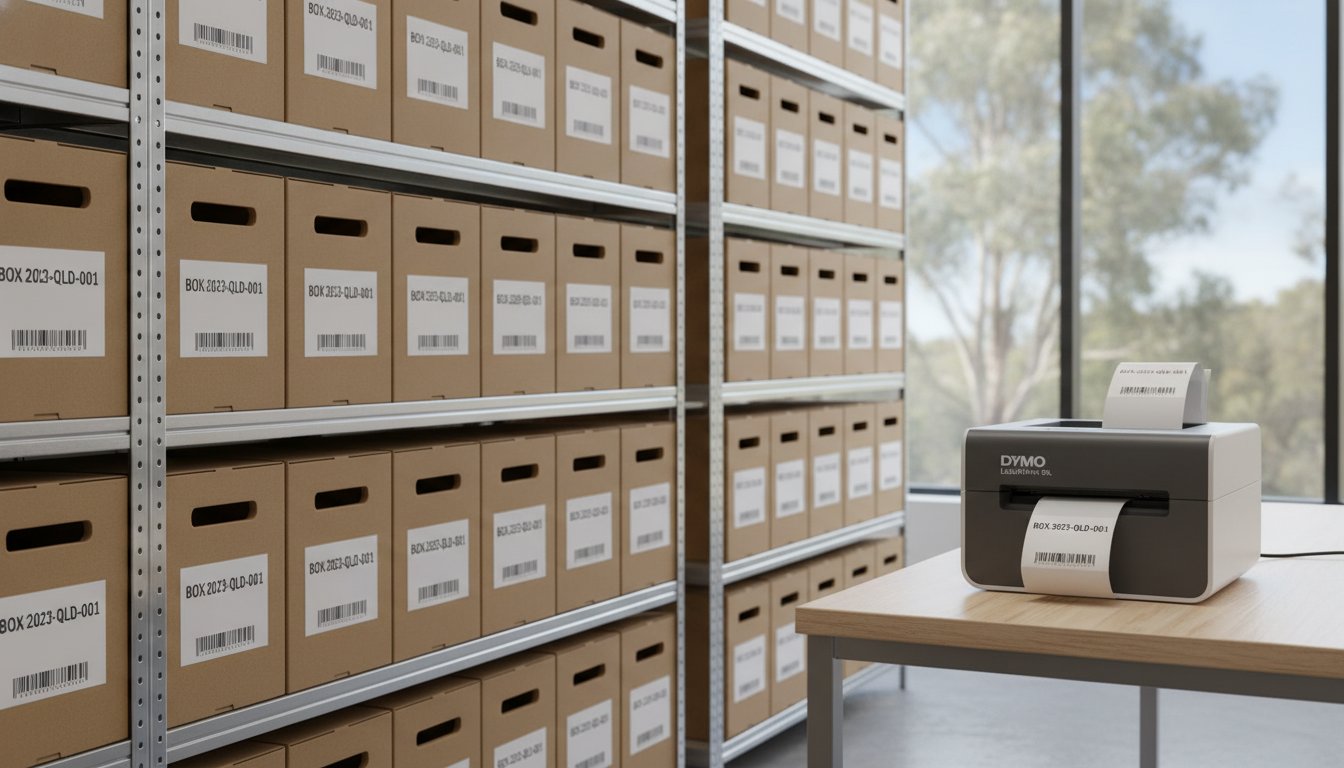
Imagine the frustration of an urgent compliance audit where the only thing standing between you and a successful outcome is a single document buried inside a wall of identical, illegibly marked boxes. Most office managers and warehouse supervisors know that a disorganised archive isn't just a nuisance; it's a liability that drains productivity and risks serious regulatory breaches. Without a professional archive box labelling system, you're often left dealing with peeling tape and smudged handwriting that makes retrieval almost impossible after only a few years in storage.
We understand that long-term records management requires more than just a felt-tip pen; it demands a structured, durable approach. In this guide, you'll discover how to design and implement a scalable labelling system that ensures your records remain accessible and compliant for years to come. We'll cover everything from selecting high-capacity hardware like the LabelWriter 5XL to choosing genuine labels that can withstand temperature fluctuations in Australian warehouses. By the end of this article, you'll have a clear blueprint for a standardised, efficient storage solution that protects your business's history and saves your team valuable time.
Key Takeaways
- Learn why a standardised archive box labelling system is vital for meeting Australian tax and legal record retention requirements.
- Discover how to design a metadata hierarchy that includes essential fields like department, contents, and box numbers for fast retrieval.
- Understand the importance of including prominent "Destroy Dates" to manage future warehouse space and ensure timely document disposal.
- Find out how to automate the labelling of hundreds of boxes at once using the wide-format LabelWriter 5XL and your existing office data.
- Ensure your labels remain legible and attached for years by using genuine DYMO labels designed for long-term storage conditions.
Why a Standardised Archive Box Labelling System is Essential for Australian Businesses
An archive box labelling system is a systematic approach to identifying, categorising, and tracking physical records through standardised data fields. While it might seem like a minor administrative detail, it forms the backbone of effective Records Management Principles within any professional environment. By moving away from haphazard notes and toward a uniform structure, businesses ensure that their historical data remains an asset rather than a warehouse full of mystery containers.
For Australian companies, this isn't just about being tidy; it's about meeting strict regulatory requirements. A reliable system provides several key benefits:
- Regulatory Compliance: The Australian Taxation Office (ATO) and various legal frameworks often require businesses to retain records for seven years. A standardised system ensures these boxes are easily identifiable and compliant during a snap audit.
- Operational Efficiency: It significantly reduces the "search and rescue" time spent by staff. When a specific contract or invoice is required, a clear, consistent label allows for instant retrieval, saving hours of manual searching.
- Professionalism: Uniform labels reflect a well-organised business. It instils confidence in both employees and auditors that the company's administrative processes are robust and reliable. Similarly, maintaining a spotless physical environment with Tidy Masters reinforces this image of operational excellence.
Beyond cleaning and labelling, efficient waste management is key to maintaining a functional archive. Even for those outside their primary service area, you can check out Book Your Dumpster USA to see how professional roll-off dumpster rentals can simplify the disposal of bulk office and warehouse waste.
Manual vs. Digital Labelling Systems
While some smaller operations still rely on felt-tip markers, the hidden costs of handwriting are significant. Illegible script and human error frequently lead to lost files and wasted hours. Digital systems using DYMO LabelWriter printers offer a far more reliable alternative. Unlike inkjet printers, thermal technology doesn't use ink or ribbons that can dry out or smudge over time. This is critical for archives that may sit in a warehouse for a decade or more.
Scalability is another major advantage. Whether you need to label a single box or manage a massive warehouse relocation, implementing a digital archive box labelling system allows you to print hundreds of durable labels in minutes. This ensures that every box, from the first to the five-hundredth, maintains the same high standard of legibility and professional appearance without the risk of fading ink.
How to Design an Effective Archive Labelling Hierarchy
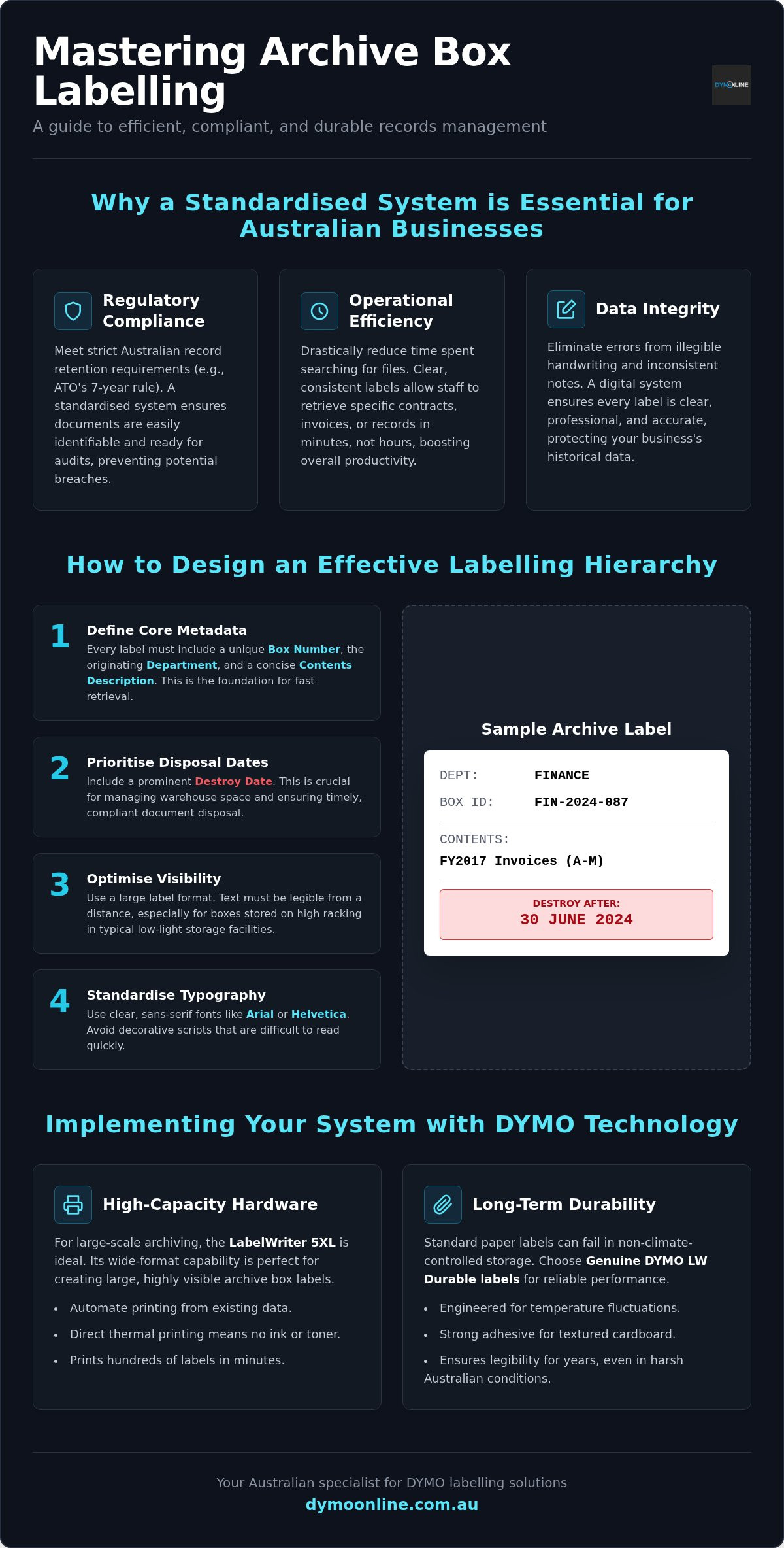
Designing a professional archive box labelling system requires a logical hierarchy of information. Without a clear structure, you're simply moving the chaos from your desk to a warehouse shelf. A well-planned archive box labelling system ensures that every person in your organisation can find what they need without confusion. To build a retrieval system that works, follow these four steps:
- Define Core Metadata: Every label must include a unique Box Number, the originating Department, and a concise Contents Description. This allows you to cross-reference the physical box with a digital register.
- Prioritise Disposal Dates: Include "Destroy Dates" in a prominent position. This is essential for managing future warehouse space and ensuring you aren't paying to store documents beyond their legal retention period.
- Optimise Visibility: Select a label size that remains legible from a distance. When boxes are stacked on high racking, small text becomes invisible.
- Standardise Typography: Use clear, sans-serif fonts like Arial or Helvetica. These styles are much easier to read in the low-light conditions typical of storage facilities.
Choosing the Right Label Material for Long-Term Storage
The environment where your boxes are stored dictates the material you should choose. Standard paper labels are suitable for clean, temperature-controlled offices. However, most archives end up in dusty warehouses or non-climate-controlled backrooms. In these conditions, standard adhesives can dry out and fail over time.
We recommend using LabelWriter LW Durable labels for any long-term archiving project. These industrial-grade labels are engineered to withstand temperature fluctuations and adhere strongly to textured surfaces like cardboard. It's also vital to use genuine consumables; generic alternatives often lack the adhesive strength required to stay attached through several Australian summers. If you need assistance choosing the right roll for your specific storage environment, feel free to contact our specialist team for expert advice.
Implementing Your System with DYMO Technology
Once you've designed your data hierarchy, the next step is choosing hardware that can handle the volume and durability requirements of long-term storage. While some competitors still promote manual vinyl sleeves or paper inserts, these methods are time-consuming and prone to damage. A modern archive box labelling system relies on high-speed thermal printing to ensure every record is clearly identified before it hits the shelf. For most Australian businesses, the DYMO LabelWriter 5XL is the gold standard for this task. Its ability to print labels up to 10cm wide makes it ideal for large archive boxes, providing enough surface area for all your metadata to be read from a distance.
One of the most significant advantages of using DYMO technology is the thermal printing process. Because these machines don't use ink or toner, you don't have to worry about ribbons drying out or text smudging during handling. This reliability is vital in Australian offices where minimising ongoing costs and maintenance is a priority. To get the best results, we recommend setting up a dedicated labelling centre in your mailroom or archive area. Having a fixed station with a LabelWriter 5XL and a stock of large-format label rolls ensures that staff can process boxes quickly and consistently.
Bulk Printing for Large-Scale Records Management
Managing a large archive project often involves labelling hundreds of boxes at once. Doing this manually is a recipe for error. By using DYMO Connect software, you can import your box lists directly from Excel or CSV files. This automation allows you to generate a complete set of labels in minutes, ensuring that every piece of data matches your digital records exactly. It's a much more efficient approach than traditional A4 sheet printing, which often results in wasted labels and alignment issues.
You can also use these digital templates to include your company logo, which helps maintain a uniform, professional brand identity across your entire warehouse. This level of detail shows auditors and clients that your record-keeping is handled with seniority and care. For more technical setup tips and advice on getting the most out of your hardware, you can refer to our Dymo LabelWriter 5XL guide. Implementing these tools doesn't just organise your boxes; it creates a scalable system that grows with your business.
Future-Proof Your Business Records
Implementing a professional archive box labelling system is an investment in your business's long-term operational health. By moving away from manual, inconsistent methods and adopting a digital hierarchy, you ensure that your records remain compliant with Australian regulations and easily accessible for years to come. Using thermal technology like the DYMO LabelWriter series eliminates the risks of smudged ink or peeling labels, providing the durability needed for harsh warehouse conditions.
As an Authorised Australian DYMO Specialist, DymoOnline provides expert support and genuine DYMO products only. We offer same-day dispatch for major metro areas to help you get your organisation project started immediately. Whether you're managing a small office or a large industrial warehouse, we have the specialised knowledge to help you choose the right tools for the job. Browse the DYMO LabelWriter range at DymoOnline today to find the perfect hardware for your archiving needs.
Taking control of your archives today will save your team countless hours of frustration and ensure your business remains audit-ready well into the future.
Frequently Asked Questions
What information must be included on an archive box label for Australian tax compliance?
For Australian tax compliance, your labels should clearly display the financial year, the record type, and the relevant business entity name. The Australian Taxation Office typically requires records to be kept for seven years, so including a specific "Destroy Date" is a practical way to manage your storage lifecycle. This allows you to identify exactly when a box can be legally disposed of, preventing the accumulation of unnecessary physical data.
How do I prevent archive labels from peeling off cardboard boxes in a hot warehouse?
You can prevent labels from lifting by using genuine DYMO Durable labels which are engineered with industrial-strength adhesive. Standard paper labels often struggle to stay attached to porous cardboard surfaces when exposed to the extreme heat of an Australian summer. These durable alternatives are specifically designed to withstand temperature fluctuations, ensuring your archive box labelling system remains intact and legible throughout its entire storage life.
Can I print archive box labels directly from my existing spreadsheet or database?
Yes, you can automate your labelling process by importing Excel or CSV files directly into the DYMO Connect software. This feature is essential for large archiving projects where manual data entry would be too slow and prone to errors. By mapping your database fields to a standardised template, you can print hundreds of unique labels in a single batch, ensuring every box matches your digital records perfectly.
What is the best label size for a standard Australian archive box?
The most effective choice for a standard archive box is a wide-format label, such as the 104mm x 159mm size. This provides enough surface area for large, bold text that stays visible when boxes are stacked high on warehouse racking. Using a LabelWriter 5XL allows you to utilise these larger formats, ensuring that all metadata and disposal dates are easy to read even in the low-light conditions typical of storage facilities.

Article by
DymoOnline Team
The DYMOOnline Team provides practical guidance for Australian businesses, warehouses, retailers, offices, schools, healthcare workplaces and home users who rely on accurate, efficient labelling. DYMOOnline specialises in DYMO label makers, DYMO label printers, label tapes, label rolls, shipping labels, address labels, barcode labels and labelling accessories, helping customers choose the right labelling products for organisation, mailing, inventory, filing, pricing and workplace efficiency.
General Information
This article is provided as general information only to help customers compare and choose DYMO label makers, label printers, label tapes, label rolls, shipping labels, address labels, barcode labels and related labelling supplies. Product details, specifications, compatibility, availability, pricing and suitability may vary. Always check the individual product page, manufacturer information, printer model compatibility and label size requirements before purchasing or using a product.
Latest News
The Ultimate Guide to Professional Archive Box Labelling Systems
Imagine the frustration of an urgent compliance audit where the only thing standing between you an...
How to Print Address Labels from Excel: A Step-by-Step Guide for Australian Businesses
How much time did your team spend this week manually typing customer addresses into a template, on...
The Truth About Dymo Labels: Myth-Busting Genuine vs Generic in 2026
On a busy Monday morning, an Australian business owner discovers their printer has ground to a hal...
Best Address Label Printer for Mac in Australia: 2026 Buying Guide
Updating your macOS shouldn't feel like a gamble with your office hardware, yet many Australian prof...
Choosing the Right DYMO LabelWriter 550 Labels: A Specialist Guide for Australian Businesses
Imagine you've just unboxed a new LabelWriter 550 Turbo, ready to streamline your warehouse shipping...
Choosing the Best 4x6 Thermal Shipping Label Printer in Australia: 2026 Buying Guide
Last Monday, a business owner named Sarah discovered that a simple calibration error on a generic pr...