
A Guide to High-Volume Labels for LabelWriter 550
Saving a few dollars on generic label rolls is often the quickest way to bring a high-volume office or warehouse operation to a complete standstill. If you've recently upgraded your hardware, you have likely discovered that dymo labelwriter 550 labels operate on a fundamentally different system than previous generations. The transition from the 450-series can feel frustrating, especially when your printer refuses to recognise labels that look identical to the ones you've used for years. This technical shift is designed to improve accuracy, but it requires a clear understanding of the new Automatic Label Recognition technology to avoid unnecessary downtime.
We recognise that reliability is your primary concern when managing large-scale labelling tasks. By mastering the specific requirements of the 550 series, you can achieve zero-waste printing and maintain seamless integration with the DYMO Connect software. This guide provides a practical overview of how these smart labels function and offers guidance on choosing between standard paper and industrial-strength durable materials from specialists like DymoOnline. You will gain the knowledge needed to ensure your printing environment remains efficient, professional, and entirely error-free.
Key Takeaways
- Understand how Automatic Label Recognition and RFID technology work together to eliminate manual setup and printing errors.
- Learn how to choose between standard paper and durable plastic materials to suit your specific office or warehouse environment.
- Discover why genuine dymo labelwriter 550 labels are essential for maintaining printer health and ensuring full compatibility with DYMO Connect software.
- Master batch printing techniques that utilise real-time data from the label roll to maximise productivity and reduce supply waste.
- Identify the environmental benefits of using genuine supplies, including FSC-certified materials that support your business's sustainability goals.
The Technology Behind DYMO LabelWriter 550 Labels: What is Automatic Label Recognition?
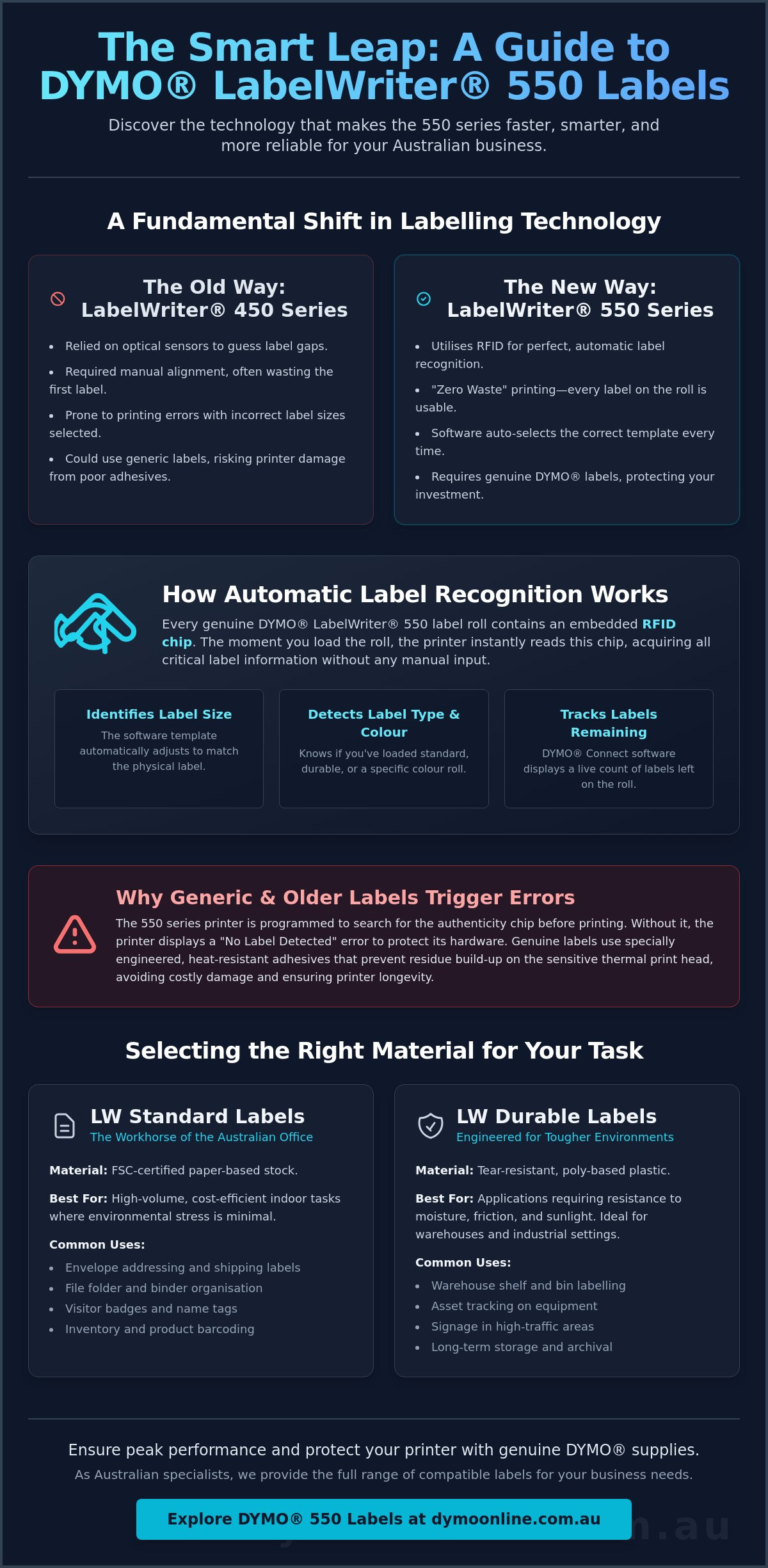
The transition from the older 450 series to the current 550 line represents a fundamental shift in how hardware and consumables interact. While previous models relied on optical sensors to detect gaps between labels, the 550 series employs a sophisticated digital handshake. Every genuine roll of dymo labelwriter 550 labels now features an embedded RFID (Radio Frequency Identification) chip within the spool. This technology allows the printer to identify the exact size, type, and colour of the labels the moment they are loaded into the machine.
The hardware-software integration is powered by direct thermal printing, which eliminates the need for messy ink or toner. A primary benefit for high-volume users is the "Zero Waste" feature. Older models frequently required a manual feed to align the roll, which typically resulted in the first label being discarded. The 550 series uses the RFID data to calibrate the start point perfectly; this ensures every single label on the roll is usable and helps businesses minimise their overheads.
Why Generic Labels Trigger Recognition Errors
If you attempt to use third-party or older 450-series rolls in a newer machine, you will likely encounter a "No Label Detected" or "Label Not Recognised" error. This occurs because the 550 series sensor is specifically programmed to search for the authenticity chip before it allows the print head to engage. This is not just a compatibility check; it is a protective measure for the machine's internal components. Genuine labels are specifically engineered with heat-resistant adhesives to prevent residue from bleeding onto the print head and causing expensive hardware failure.
Real-Time Inventory Tracking for High-Volume Offices
Australian medical clinics and law firms often operate on tight schedules where administrative delays are not an option. The DYMO Connect for Desktop software provides a live visual interface that displays the exact number of labels remaining on the current roll. This allows staff to monitor inventory across multiple workstations from a single interface, making it easier to organise replenishment before a roll runs dry. Additionally, because the printer communicates the label dimensions to the software automatically, the digital template updates instantly. This removes the risk of printing a small address on a large shipping label, saving both time and material costs in fast-paced environments.
Standard vs Durable LW Labels: Selecting the Best Material for Your Environment
Choosing the correct material for your dymo labelwriter 550 labels is a decision that directly impacts the longevity of your organisational systems. Both the Standard and Durable ranges utilise direct thermal printing technology. This means the printer uses heat to create the image on chemically treated material, completely removing the need for expensive ink cartridges or toner. The primary difference between these two categories lies in the base material and the chemical composition of the adhesive used to secure the label to its surface.
Standard labels are typically paper-based and designed for high-volume tasks where cost-efficiency is the priority. In contrast, the Durable range is constructed from a poly-based plastic material. This material choice affects how the labels respond to friction, sunlight, and moisture. Understanding these differences ensures that your labelling remains legible and intact throughout the entire lifecycle of the item being tracked.
LW Standard Labels: The Workhorse of the Australian Office
Standard paper-based labels are designed for high-volume administrative tasks where environmental stress is minimal. They are the most economical choice for indoor applications such as envelope addressing, file folder labelling, and printing visitor badges. These labels provide excellent adhesion to common office surfaces, including paper, cardboard, and smooth plastics. For most small businesses and home offices, these rolls offer the most efficient way to manage daily logistics without exceeding the budget.
LW Durable Labels: Engineered for Australian Warehouses and Labs
In more demanding environments, such as unconditioned Australian warehouses or medical laboratories, paper labels often fail. LW Durable labels are manufactured from a robust plastic material that resists moisture, oils, and common cleaning solvents. They are significantly more tear-resistant than paper alternatives and can withstand extreme temperature fluctuations. This makes them suitable for shelf labelling or identifying chemical containers where maintaining a clear Hazard Communication Standard is vital for safety and compliance.
The adhesive on the Durable range is industrial-strength, ensuring the label remains attached even when exposed to friction or dampness. If you are operating in a sector with specific compliance requirements or harsh environmental factors, consulting with our specialist team can help you determine which specific roll width and material will best support your workflow. Selecting the right material from the start prevents the need for frequent re-labelling and reduces overall waste.
A Guide to Sizes and Formats: Matching Label Dimensions to Professional Tasks
Selecting the right dimensions for dymo labelwriter 550 labels is no longer a manual process of trial and error. The LabelWriter 550 and its faster sibling, the 550 Turbo, are designed to accommodate a wide variety of roll widths. Once you drop a roll into the printer, the Automatic Label Recognition technology communicates the exact dimensions to your computer. This means the DYMO Connect software instantly adjusts the digital workspace to match the physical label. You don't have to scroll through endless menus to find the right template; the system does it for you. This automation is particularly useful in Australian medical practices and schools where staff frequently switch between different labelling tasks throughout the day.
Mailing and Shipping Label Standards
Standard address labels (28mm x 89mm) are the go-to for Australian office administration. For international parcels or larger envelopes, the Large Address format provides extra space for customs details or longer addresses. While the 550 series handles standard shipping labels well, high-volume e-commerce businesses requiring 104mm x 159mm formats should consider the LabelWriter 5XL as the dedicated solution for wide-format tasks. These genuine supplies integrate perfectly with Australia Post's MyPost Business and other local courier platforms, ensuring that barcodes remain crisp and scannable during transit.
Multi-Purpose and Small Format Labels
Retailers often require square or round labels for branding product packaging or creating price tags. Small multi-purpose labels are ideal for asset management, such as barcoding IT equipment or labelling cables in a server room. For tasks that require unique lengths, continuous label rolls allow you to print custom-length signage or long-form barcodes without being restricted by pre-cut dimensions. Specialty formats like jewellery tags and appointment cards are also available to support specific professional workflows in medical and retail sectors. Using the correct format ensures your business maintains a professional image while improving daily operational speed.
For businesses in the hospitality industry, maintaining high standards of food safety is equally critical; solutions from LabelFood demonstrate how specialised labelling can be integrated into commercial kitchen workflows to ensure compliance and efficiency.
While DIY labels are excellent for internal logistics, businesses aiming for a cohesive brand identity often complement these with professional litho solutions; for instance, Print It ZA print and packaging offers specialised services for business cards and premium packaging that set a high standard for corporate presentation.
Maximising Efficiency with Genuine 550 Series Labels and Software
The synergy between your hardware and software is the foundation of a productive labelling station. DYMO Connect for Desktop utilises the live RFID data from dymo labelwriter 550 labels to streamline the entire design process. When the software knows exactly which roll is loaded, it removes the guesswork from alignment and font sizing. This integration is particularly powerful when you need to import data directly from Microsoft Office or Google Contacts. You can pull an entire list of addresses into the interface and print a complete batch in seconds without manually adjusting a single template.
High-volume runs require hardware that can maintain pace without interruption. The LabelWriter 550 series handles these intensive tasks by relying on the precision-cut backing of genuine rolls. This manufacturing quality prevents the slipping or jamming that often occurs with inferior alternatives. Using genuine supplies also reduces the frequency of required maintenance. Because the adhesives are engineered to withstand the heat of the print head, they don't leave behind the sticky residue that typically necessitates the frequent use of cleaning cards.
Troubleshooting Common Recognition Issues
Occasionally, a genuine roll might not be detected by the 550 sensor upon first installation. This is usually due to a small amount of dust or debris obstructing the internal optical sensor that reads the RFID chip. Gently cleaning the sensor area with a lint-free cloth often restores consistent communication. If you continue to experience connectivity problems, our DYMO Troubleshooting Guide provides more advanced technical fixes for Australian businesses. Keeping your firmware updated through the software also ensures the latest label formats are recognised correctly.
Bulk Labelling Strategies for Australian SMEs
Managing inventory for a growing business requires both smart storage and cost-effective purchasing. In the Australian climate, it's vital to store your label rolls in a cool, dry place to prevent thermal degradation from heat exposure. For organisations with high-frequency printing needs, utilising "Value Packs" is an effective way to reduce the cost-per-label. You can explore our range of Bulk DYMO supplies to find larger quantities that offer significant operational savings. If you need assistance choosing the right volume for your specific warehouse or retail environment, reach out to our specialist team for tailored advice.
Why Genuine DYMO Labels are the Only Choice for the 550 Series
The decision to use genuine dymo labelwriter 550 labels involves more than just ensuring software compatibility. While the initial cost of third-party rolls may seem lower, the long-term risk to your hardware and the potential for failed deliveries due to unreadable barcodes creates a much higher total cost of ownership. Using non-genuine supplies can also complicate your standing regarding Australian Consumer Law protections. If a printer failure is directly caused by the physical properties of a generic label, such as adhesive leakage or poor backing material, it may be classified as user-induced damage rather than a manufacturing fault.
Sustainability is another factor that distinguishes genuine supplies from generic alternatives. DYMO has made a clear commitment to environmental responsibility by using FSC-certified materials for their paper labels. This ensures the paper is sourced from responsibly managed forests. Additionally, many components of the label rolls include recycled materials, helping your business maintain its own environmental targets while ensuring high-quality administrative output. For high-volume users, choosing Value Packs is a smart way to balance these ethical considerations with the need for operational cost-efficiency.
Quality Assurance and Print Longevity
The science behind genuine thermal paper ensures that your printed data remains legible for the duration of its intended use. Generic labels often use inferior chemical coatings that are prone to rapid fading when exposed to the UV light and heat common in Australian environments. This is a critical failure point for shipping labels that must survive long-haul transit across the country. The adhesive integrity of genuine rolls is also specifically tested to ensure it remains bonded to various surfaces without peeling. The precise die-cutting of genuine rolls ensures consistent spacing and prevents the adhesive bleed that frequently causes printer jams.
Sourcing from an Australian Specialist
Working with a dedicated local partner like DymoOnline provides your business with access to specialised expertise that generic office resellers cannot match. We understand the specific logistics challenges faced by Australian SMEs, from unconditioned warehouse environments to high-pressure medical administration. Our team offers nationwide shipping with the reliability of same-day dispatch for metro areas, ensuring your workflow isn't interrupted by supply shortages. By choosing a specialist Australian online store, you gain a partner that stands behind the authenticity and performance of every roll.
Browse the full range of LabelWriter 550 labels here to find the perfect match for your professional requirements.
Optimising Your Professional Labelling Workflow
Transitioning to the 550 series allows your business to embrace a more automated, data-driven approach to organisation. By utilising the smart capabilities of dymo labelwriter 550 labels, you've eliminated the frustration of misaligned prints and first-label waste. Whether you're managing administrative files with standard paper or securing assets in a warehouse with durable plastic, selecting the correct material ensures your professional standards are maintained. This shift from manual setup to hardware-software synchronisation is the key to achieving a truly efficient workspace.
As an official DymoOnline specialist, we provide the technical expertise and local support needed to keep your operations running smoothly. Our commitment to nationwide Australian shipping and expert technical support ensures that you're never left without the supplies or knowledge required for high-volume tasks. If you need assistance selecting the right roll dimensions or material for your specific environment, contact our expert team today. We're here to help you build a more organised and reliable labelling environment.
Frequently Asked Questions
Can I use my old LabelWriter 450 labels in the new 550 printer?
No, the 550 series exclusively requires genuine rolls with embedded RFID chips to function. While the physical dimensions of older 450-series labels might match, the lack of an Automatic Label Recognition chip prevents the printer from engaging. This technical requirement ensures the printer can verify the label type and count before starting a print job, preventing alignment errors and wasted materials.
Why is my DYMO 550 saying "No Label Detected" with a new roll?
This error usually indicates the printer cannot communicate with the RFID chip on the roll. Ensure you have loaded genuine dymo labelwriter 550 labels and that the roll is seated firmly on the spool. If the error persists with a genuine roll, check for dust on the internal sensors or verify that your firmware is updated via the DYMO Connect software to ensure the latest formats are recognised.
Are DYMO LabelWriter 550 labels waterproof or chemical resistant?
Standard paper labels are not moisture-resistant, but the LW Durable range is engineered for these specific conditions. Durable labels are made from a poly-based plastic that resists water, oils, and common cleaning solvents. While they withstand significant environmental stress in Australian warehouses and labs, they are not rated for permanent submersion or extreme chemical exposure without specific industrial testing.
How many labels are typically on a standard address label roll?
The quantity depends on the specific format; a standard address roll (28mm x 89mm) typically contains 130 labels. High-volume users often opt for Large Address rolls, which feature 260 labels to reduce the frequency of roll changes. Because the 550 series tracks usage digitally, the software provides a live count of exactly how many labels remain on your current spool during high-volume runs.
Do I need to buy ink or toner for the LabelWriter 550?
No, this printer uses direct thermal printing technology. The image is created by applying heat to the chemically treated surface of the label material itself. This eliminates the need for ink, toner, or thermal ribbons, which simplifies maintenance and reduces ongoing costs. As long as you use genuine thermal labels, you can print thousands of crisp barcodes and addresses without any additional consumable requirements.
What is the difference between LW Standard and LW Durable labels?
The difference lies in the material composition and adhesive strength. LW Standard labels are paper-based for everyday office tasks like envelope addressing or folder management. LW Durable labels are made from plastic and feature industrial-strength adhesive. This allows the Durable range to stay attached and legible on metal or plastic surfaces even when exposed to friction, moisture, or temperature fluctuations in unconditioned environments.
Where can I find the software to print on my 550 labels?
You can download DYMO Connect for Desktop from the official DYMO website. The latest version (v1.6) is compatible with Windows 10 and higher and macOS 14 and higher. The software is essential for the 550 series as it reads the RFID data from the dymo labelwriter 550 labels to automatically select the correct template for your specific label dimensions, ensuring perfect alignment every time.
Does DYMO offer bulk discounts for large label orders in Australia?
Yes, businesses can access significant savings by purchasing Value Packs or bulk quantities through DymoOnline. These larger packs are designed for warehouses and retailers with high daily output, effectively lowering the cost-per-label. Choosing a specialist Australian online store also ensures you receive local technical support and reliable nationwide shipping for your high-volume supply requirements, helping you maintain consistent inventory levels.

Article by
DymoOnline Team
The DYMOOnline Team provides practical guidance for Australian businesses, warehouses, retailers, offices, schools, healthcare workplaces and home users who rely on accurate, efficient labelling. DYMOOnline specialises in DYMO label makers, DYMO label printers, label tapes, label rolls, shipping labels, address labels, barcode labels and labelling accessories, helping customers choose the right labelling products for organisation, mailing, inventory, filing, pricing and workplace efficiency.
General Information
This article is provided as general information only to help customers compare and choose DYMO label makers, label printers, label tapes, label rolls, shipping labels, address labels, barcode labels and related labelling supplies. Product details, specifications, compatibility, availability, pricing and suitability may vary. Always check the individual product page, manufacturer information, printer model compatibility and label size requirements before purchasing or using a product.
Latest News
Asset Labelling Solutions for Australian Schools: The 2026 Buying Guide
Imagine walking into a classroom at the end of term only to find that dozens of new student laptop...
The Ultimate Guide to Professional Archive Box Labelling Systems
Imagine the frustration of an urgent compliance audit where the only thing standing between you an...
How to Print Address Labels from Excel: A Step-by-Step Guide for Australian Businesses
How much time did your team spend this week manually typing customer addresses into a template, on...
The Truth About Dymo Labels: Myth-Busting Genuine vs Generic in 2026
On a busy Monday morning, an Australian business owner discovers their printer has ground to a hal...
Best Address Label Printer for Mac in Australia: 2026 Buying Guide
Updating your macOS shouldn't feel like a gamble with your office hardware, yet many Australian prof...
Choosing the Right DYMO LabelWriter 550 Labels: A Specialist Guide for Australian Businesses
Imagine you've just unboxed a new LabelWriter 550 Turbo, ready to streamline your warehouse shipping...