

Professional cable marking is a safety requirement, not just an organisational choice. In demanding Australian industrial environments, heat shrink tubing is the only "fit-and-forget" solution for permanent identification. You've likely dealt with standard labels peeling off in high-heat or greasy conditions, or perhaps you're tired of handwritten markers that look unprofessional and fail to meet compliance. It's a common frustration to find your hard work undermined by a label that simply won't stay put.
By using a specialised heat shrink tubing label maker, you can ensure your work meets the current ANSI/TIA-606-D standards for telecommunications infrastructure while providing the durability required by UL 969. This guide explains how to select, print, and apply industrial-grade heat shrink labels to create permanent wire markings for any Australian project. We'll preview essential printer models like the Rhino 4200 or 6000+, explore the science behind polyolefin materials, and help you establish a streamlined labelling workflow. As a specialist Australian online store, DYMOOnline provides the technical guidance you need to choose the right tools for a compliant, professional result.
Key Takeaways
- Learn why polyolefin material and 3:1 shrink ratios provide the most reliable, flame-retardant fit for professional cable identification.
- Understand why a specialised heat shrink tubing label maker is required to handle industrial cartridges and provide the necessary "hotkey" functionality.
- Master the step-by-step process of printing and applying sleeves to ensure your markings remain permanent and legible in greasy or high-heat conditions.
- Find out how to maintain compliance with Australian standards by sourcing genuine Rhino Industrial labels from a specialist local supplier like DYMOOnline.
What is a Heat Shrink Tubing Label Maker and Why Do Professionals Use Them?
A heat shrink tubing label maker is a specialised thermal transfer printer engineered to print directly onto non-adhesive, polyolefin sleeves. Unlike a standard office label maker that uses adhesive-backed vinyl or polyester tapes, these industrial machines utilise heat to bond ink to a continuous tube. This process ensures the text won't smudge or fade even when the sleeve is subjected to intense heat during the shrinking process. It's a tool designed for environments where failure isn't an option.
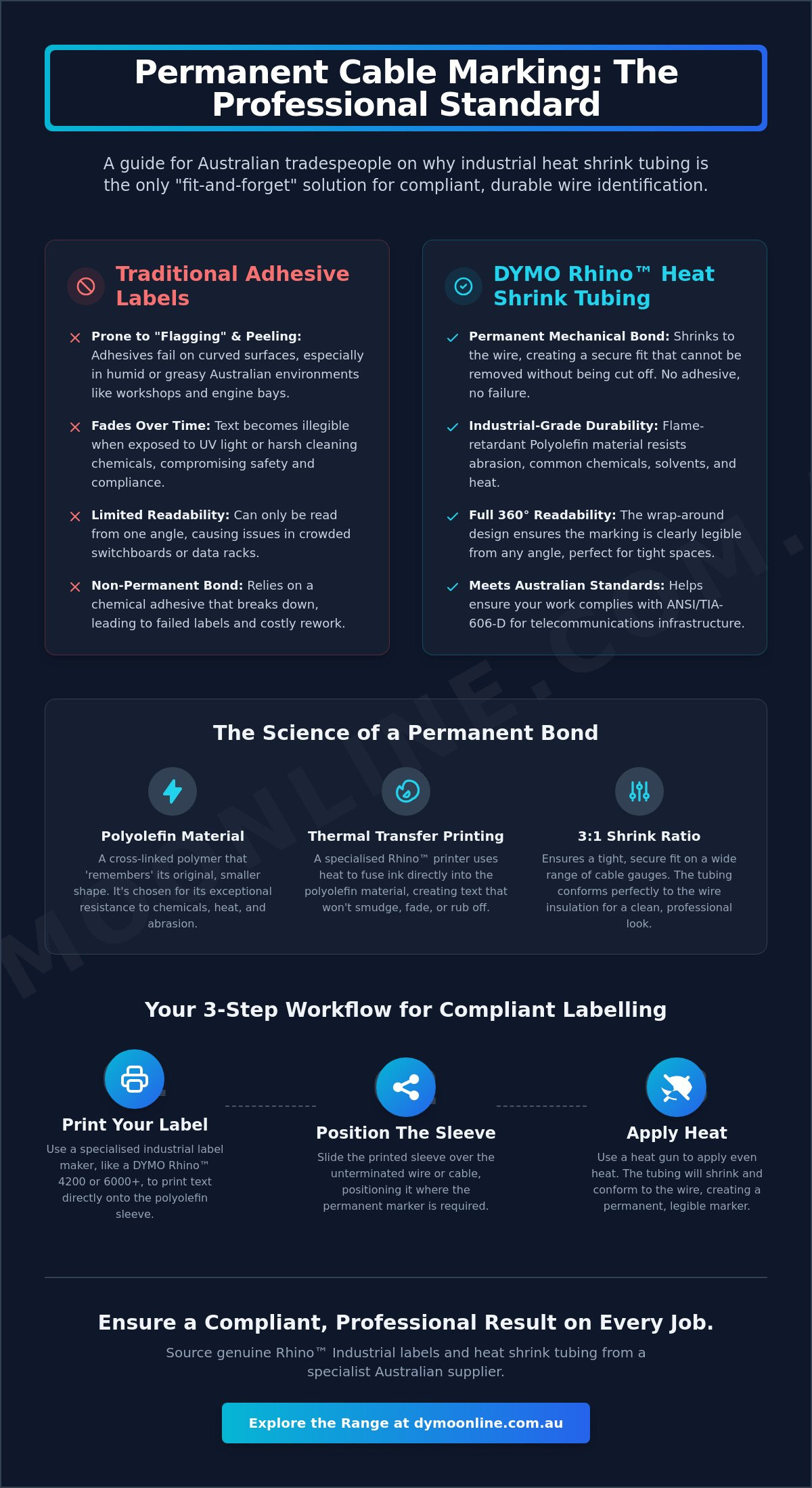
For many Australian tradespeople, the shift from standard tapes to Heat-shrink tubing represents a move toward permanent cable management. The primary advantage is the 360-degree legibility it provides. Because the label wraps entirely around the wire, you can identify the cable from any angle without needing to rotate it. This is particularly useful in cramped switchboards or dense data centre racks where visibility is limited and space is at a premium.
To better understand how this technology works in a practical setting, watch this helpful video:
Standard labels rely on chemical adhesives to stay in place. In contrast, heat shrink sleeves create a permanent mechanical bond. Once the tube is heated and shrunk around the wire, it cannot be removed without cutting it off. This makes it the preferred choice for automotive wiring, industrial machinery, and telecommunications infrastructure across Australia. It provides a level of security that sticky labels simply cannot match.
The Problem with Traditional Adhesive Labels
Traditional adhesive labels often suffer from a phenomenon known as "flagging." This occurs when the edges of the label begin to lift and peel away from the curved surface of a cable. In humid Australian environments or areas with high oil and grease exposure, such as workshops and engine bays, adhesives can break down rapidly. There's also a significant risk of fading. If labels are exposed to UV light or harsh chemical cleaners, the text can become illegible within months. Heat shrink sleeves eliminate these risks by removing the adhesive element from the equation entirely.
Key Benefits for Australian Contractors
Using a dedicated Industrial Rhino printer to create these labels offers immediate professional advantages. A tidy, compliant installation justifies higher contract rates because it demonstrates a commitment to quality and longevity. These markings ensure your work aligns with Australian electrical and telecommunications standards, including ANSI/TIA-606-D.
By investing in genuine Rhino Industrial labels, contractors also reduce long-term maintenance costs. You won't need to return to a site to replace peeling or faded markers. This "one-and-done" approach saves time and protects your reputation as a reliable professional. Whether you're working on a residential solar install or a large-scale commercial fit-out, the result is a clean, permanent, and easily identifiable wiring system.
The Science of Permanent Marking: Polyolefin and Shrink Ratios
The durability of a professional cable marker isn't accidental; it's the result of precise material science. Polyolefin is the industry-standard polymer used for these sleeves because of its exceptional resistance to chemicals, heat, and abrasion. Unlike generic plastics, polyolefin is cross-linked, which allows it to "remember" a smaller shape when heated. This material must adhere to ASTM D2671 international standards, which define the rigorous test methods for its performance in industrial settings.
A high-quality heat shrink tubing label maker relies on thermal transfer printing to create permanent text. In this process, the print head applies heat to a ribbon, fusing the ink directly into the polyolefin fibres. This creates a mark that won't smudge, even if handled with greasy hands or wiped with cleaning solvents. Genuine DYMO tubing undergoes extensive testing to ensure it survives temperatures up to 125 degrees Celsius without degrading. While standard PVC might crack or degrade under UV exposure, polyolefin remains stable, ensuring your cable identification stays legible for decades.
Understanding Technical Standards and Certifications
Professional installations often require adherence to specific durability benchmarks. The MIL-STD-202G standard is a common requirement, ensuring that the label can withstand high-frequency vibrations and exposure to harsh solvents without losing legibility. For Australian contractors, UL 224 recognition is equally important, as it confirms the sleeve meets established safety requirements for electrical insulation. Flame retardant ratings are critical in switchboard environments because they ensure the labelling material will not facilitate the spread of fire during an electrical fault.
Selecting the Correct Tubing Diameter
Choosing the right size is essential for a secure fit. You must measure the wire's outer diameter (O.D.), including the insulation, rather than relying on the copper gauge alone. The "Goldilocks" rule applies here: you want a sleeve that slides over the wire and any connectors easily but is small enough to shrink tightly once heat is applied. The Rhino Industrial series supports various widths, including 6mm, 9mm, and 12mm cartridges, to accommodate different cable thicknesses.
Most DYMO Rhino tubing features a 3:1 shrink ratio. This means a 12mm tube will shrink down to approximately 4mm, providing a much broader fit range than a standard 2:1 ratio. This higher ratio is particularly useful when you need to slide a label over a pre-terminated lug or connector before shrinking it onto the smaller wire behind it. If you're unsure which width suits your specific project, you can always reach out to our specialist team for technical advice.
Choosing the Right Industrial Label Maker for Heat Shrink Tubing
A common mistake is assuming any label maker can handle industrial sleeves. Standard office printers are designed for thin polyester films and lack the torque or clearance required for polyolefin cartridges. A dedicated heat shrink tubing label maker is built with a reinforced drive mechanism to ensure consistent feeding and crisp thermal transfer. This isn't just about aesthetics; it's about meeting workplace electrical safety regulations that mandate clear, durable identification for all conductors.
Industrial "Hotkeys" are the defining feature of the Rhino Industrial series. These buttons allow you to select the "Heat Shrink" mode instantly, which automatically centres the text and adjusts the length based on your specific wire diameter. This prevents the wasted material often seen when trying to "hack" a standard printer for industrial use. It ensures that every sleeve you print is perfectly sized for the job at hand.
Australian construction sites are tough on gear. Dust, heat, and drops are inevitable. Professional-grade machines feature integrated rubber bumpers to absorb impact and protect the internal print head. For power, you have choices. Li-ion rechargeable packs are ideal for high-volume days, while AA battery compatibility provides a reliable fallback when you're working in remote areas without easy access to a charging point. This flexibility is vital for maintaining a productive workflow in the field.
The DYMO Rhino Series: Handheld Versatility
For most field technicians, the choice falls between the Rhino 4200 and the Rhino 5200. The 4200 is compact and features a QWERTY keyboard, making it intuitive for quick labels. The 5200 is the industry workhorse, offering more advanced formatting and a "Favourites" key to store your most used cable sizes. Both models are wrapped in protective bumpers, ensuring they survive a tumble from a ladder or a messy toolbox. They are designed to be used with one hand, leaving your other hand free to manage the cabling.
Advanced Labelling with the Rhino 6000+
Large-scale projects like data centre fit-outs require a more sophisticated workflow. The Rhino 6000+ allows you to import complex wire lists directly from Excel via PC connectivity. This eliminates manual typing errors and significantly speeds up the labelling of hundreds of cables. It also features an automatic cutter, which is a major time-saver during repetitive tasks. To protect this investment, many professionals opt for a durable carry case to keep the printer and spare cartridges organised and safe from site debris.
Step-by-Step: How to Print and Apply Heat Shrink Labels Correctly
Achieving a professional result with a heat shrink tubing label maker requires a disciplined workflow. It begins with selecting the correct Heat Shrink Tubing cartridge for your cable's outer diameter. Before you start printing, ensure the cable surface is free from heavy grease or dust. While the sleeve doesn't rely on adhesive, a clean surface prevents the tube from sliding or rotating during the shrinking process, ensuring the text remains exactly where you need it.
Load the cartridge into your Rhino printer and press the "Heat Shrink" hotkey. This mode is the brain of the operation; it automatically centres your text and ensures the printable area matches the tube width. If you have multiple cables to identify, use the "Serial" or "Repeat" functions. These allow you to print a sequence of IDs in one go, which is significantly more efficient than typing each label individually. Once printed, use the integrated cutter to separate the sleeves.
Timing is everything during application. You must slide the printed sleeve onto the wire before you crimp any terminals or lugs. Once the cable is terminated, it's often impossible to fit the sleeve over the connector, even with a 3:1 shrink ratio. Position the label so it's clearly visible after the cable is installed in the switchboard or rack. This foresight saves hours of troubleshooting during future maintenance or audits.
Printing Tips for Maximum Legibility
For small-diameter tubing like 6mm or 9mm, always use the "Bold" font setting. This increases the surface area of the thermal transfer ink, making the text much easier to read in low-light environments like server rooms. If you're identifying long cable runs, use the "Repeat" function to print the same ID twice on a single sleeve. This ensures the identification is visible regardless of how the cable twists. Always verify that the cartridge has clicked firmly into place to prevent ribbon jams or misaligned text.
Best Practices for Using a Heat Gun
Shrinking requires controlled heat, not just raw power. Set your heat gun to a medium temperature, typically between 210 and 250 degrees Celsius, to trigger the shrink without scorching the polyolefin. Use a steady, sweeping motion while rotating the cable to ensure an even 360-degree shrink. This prevents "hot spots" that can make the material brittle. In Australian workplaces, never use lighters or open flames for shrinking; this is a significant safety hazard and will likely damage the wire insulation.
If you're managing a large-scale project and need help selecting the right cartridges for your specific cable gauges, get in touch with our technical team for expert guidance.
The DYMO Rhino Advantage: Industrial-Grade Solutions for Australian Workplaces
Choosing a professional heat shrink tubing label maker is an investment in the long-term safety and clarity of your electrical infrastructure. In the Australian market, the DYMO Rhino series has established itself as the benchmark for reliability. This reputation is built on decades of presence in the industrial sector, providing tools that withstand the rigours of local worksites. When you source your equipment from a specialist Australian online store like DYMOOnline, you aren't just buying a printer; you're accessing a professional knowledge base and a reliable supply chain tailored to local requirements.
The DYMO ecosystem is designed to be a total organisational solution. Many contractors utilise a Rhino handheld for rugged field applications while maintaining a LabelWriter 550 in the office for administrative tasks and shipping labels. This consistency across your labelling hardware ensures that your team remains productive, whether they are commissioning a switchboard on-site or managing inventory in the warehouse. It's a streamlined approach that prioritises efficiency and professional standards.
Genuine vs. Generic: The Hidden Risks
It is tempting to consider third-party alternatives, but the risks to your equipment and reputation are significant. Non-genuine tubing is often manufactured with inconsistent polyolefin blends that can crack under the thermal stress of a heat gun. Poor ink adhesion is another common failure, leading to identification that wipes off during installation. Perhaps most importantly, generic cartridges can cause physical damage to the printer head by failing to feed correctly through the drive mechanism. Using genuine Rhino Industrial labels ensures your project remains compliant with safety standards and protects your manufacturer warranty.
Finding the Right Supplies for Your Industry
Different sectors have unique requirements. Solar installers need UV-stable markings that survive the harsh Australian sun, while data cablers require high-volume serialisation for complex server racks. We provide specialised materials for every application, including flexible nylon for curved surfaces and permanent polyester for flat panels. For large-scale infrastructure projects, local availability is critical. DYMOOnline maintains significant stock levels to support bulk purchasing for industrial fit-outs, ensuring you don't face project delays due to supply shortages.
Our team understands the technical specifications of the Australian electrical environment and can provide the guidance needed to choose the correct tubing widths and printer models. Browse the full range of Rhino Industrial printers and tubing at DYMOOnline to secure the tools required for your next compliant installation.
Elevate Your Cable Identification Standards
Implementing a professional labelling system is about more than just organisation; it's a commitment to safety and long-term operational efficiency. By mastering the use of a heat shrink tubing label maker, you ensure that every cable in your installation remains identifiable for the life of the system. We've explored how polyolefin material provides the mechanical bond necessary for harsh Australian environments and why industrial hotkeys are vital for a streamlined workflow. These tools transition your work from temporary marking to a permanent, compliant solution.
Choosing genuine hardware and supplies protects your reputation and your equipment from the risks associated with generic alternatives. At DYMOOnline, we provide the genuine DYMO industrial durability required for large-scale infrastructure projects. Our team offers specialist Australian support to help you select the right cartridges and printers for your specific industry needs. With nationwide shipping from Mega Office Supplies, you can maintain your project timelines without compromise. Taking the time to apply these permanent markings correctly today prevents costly troubleshooting and re-labelling in the future. We're here to help you build a more reliable and compliant workplace.
Contact our specialist team to find the right labelling solution for your project
Frequently Asked Questions
Can I use heat shrink tubing in a standard DYMO LabelManager?
No, standard DYMO LabelManager models are designed exclusively for D1 polyester and vinyl tapes. To use industrial sleeves, you require a specialised heat shrink tubing label maker from the Rhino series, such as the 4200, 5200, or 6000+. These machines feature reinforced drive motors and wider internal clearances to handle the increased thickness of polyolefin cartridges without jamming or damaging the print head.
What is the best shrink ratio for electrical wire marking?
A 3:1 shrink ratio is the industry benchmark for professional electrical marking. This ratio is superior to 2:1 because it provides a much broader fit range, allowing the sleeve to slide easily over pre-terminated lugs or bulky connectors before shrinking tightly onto the smaller wire behind them. This ensures a secure, mechanical bond that prevents the label from sliding or rotating once installed in a switchboard.
Do heat shrink labels fade when exposed to sunlight or chemicals?
Genuine DYMO polyolefin tubing is engineered to resist fading in harsh environments. The material is tested against UV exposure and common industrial solvents, including oils and cleaning agents, to ensure long-term legibility. Because the thermal transfer process fuses the ink into the material fibres, the text remains crisp and readable even in the demanding conditions often found on Australian industrial sites or outdoor solar installations.
Is a hair dryer powerful enough to shrink industrial polyolefin tubing?
No, a standard hair dryer cannot reach the temperatures required to properly shrink industrial-grade polyolefin. You need a dedicated heat gun capable of reaching between 210 and 250 degrees Celsius to trigger the shrinking process effectively. Using insufficient heat results in a loose fit that fails to provide the permanent identification required for compliance with Australian electrical safety standards.
Can I print barcodes on heat shrink tubing for asset tracking?
Yes, you can print barcodes on tubing, particularly when using the Rhino 6000+ model. This heat shrink tubing label maker supports various barcode types, including Code 39 and Code 128. For the best results, we recommend using 12mm or wider tubing to ensure there is enough surface area for a scanner to read the code accurately after the material has undergone the shrinking process.
What happens if I use a sleeve that is too large for the wire?
If the sleeve's fully shrunk diameter is larger than the wire's outer diameter, the label will remain loose. This creates a "floating" label that can slide down the cable or rotate, making it difficult to read during maintenance. To ensure a permanent fit, always check that the wire diameter falls within the specific range listed for your chosen 6mm, 9mm, or 12mm Rhino cartridge.
Are DYMO heat shrink labels compliant with Australian electrical standards?
Yes, genuine DYMO heat shrink sleeves meet rigorous international benchmarks like UL 224 and MIL-STD-202G. These certifications are widely recognised in Australia as evidence of durability, flame retardancy, and resistance to environmental stress. Using these compliant materials ensures your work meets the high standards required for telecommunications infrastructure, government projects, and heavy industrial fit-outs across the country.
How do I prevent the ink from smudging on the tubing?
To prevent smudging, always use genuine Rhino cartridges and select the "Heat Shrink" mode on your printer. This setting calibrates the thermal print head to the exact temperature needed to fuse the ink into the polyolefin material. Avoid touching the printed surface immediately after it exits the machine; allowing just a few seconds for the ink to set ensures a permanent, smudge-proof finish that survives heavy handling.
General Information
This article is provided as general information only to help customers compare and choose DYMO label makers, label printers, label tapes, label rolls, shipping labels, address labels, barcode labels and related labelling supplies. Product details, specifications, compatibility, availability, pricing and suitability may vary. Always check the individual product page, manufacturer information, printer model compatibility and label size requirements before purchasing or using a product.


